Blog

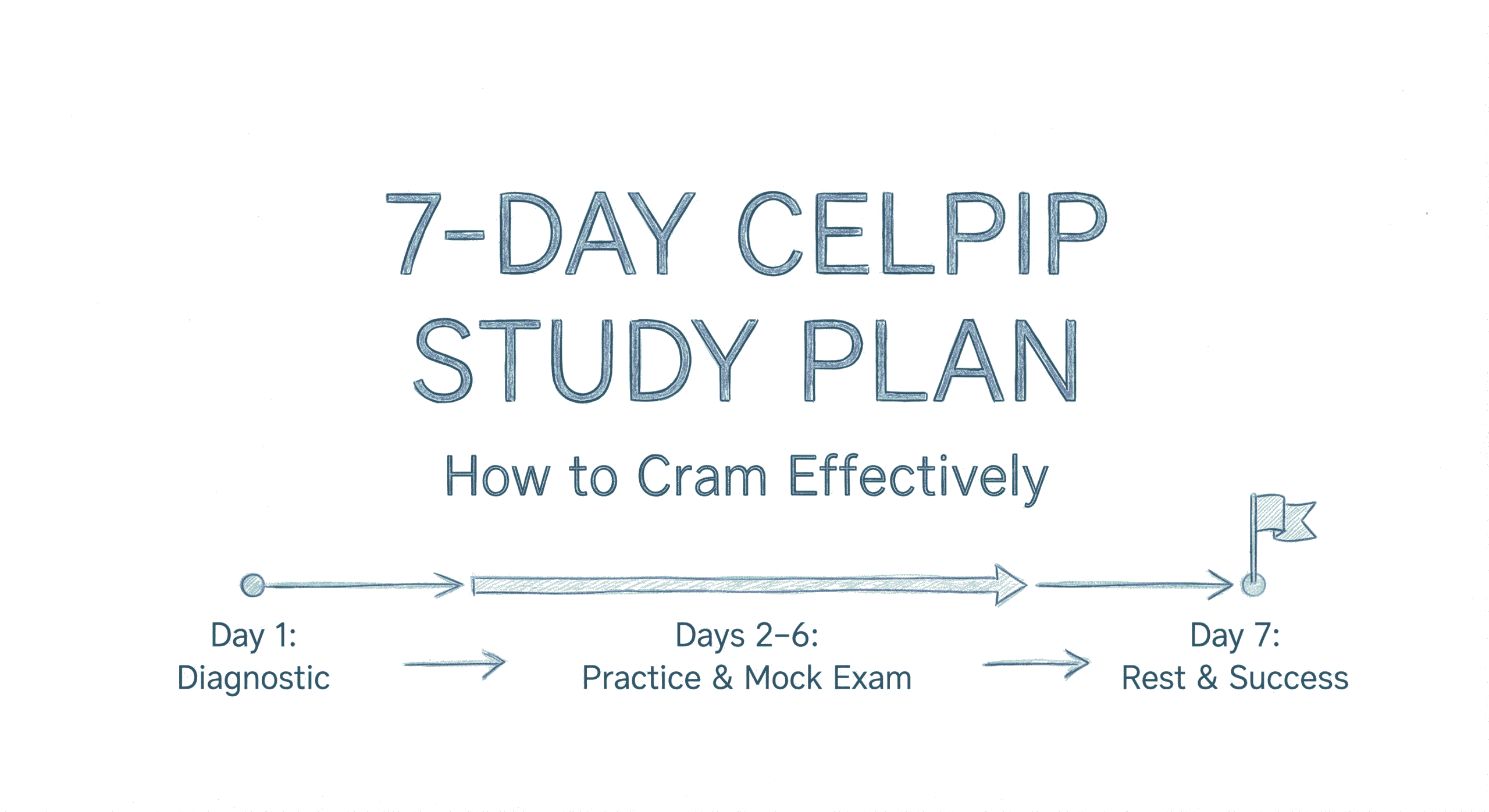
  • 7-Day CELPIP Study Plan: How to Cram Effectively

    7-Day CELPIP Study Plan: How to Cram Effectively

    The test is in one week. You have barely started studying. Panic is setting in. Can you actually prepare in just one week?

    Surprisingly, the answer is yes. While you cannot learn a whole new language in a week, you can master the test format. A strategic 7-Day CELPIP study plan is not about learning English; it is about learning how to take the CELPIP.

    Specifically, you need to focus on structure, timing, and avoiding common traps. Below is a high-intensity schedule designed to maximize your score in minimum time.

    The Golden Rule of the 7-Day CELPIP Study Plan

    Admittedly, cramming is not ideal. However, if you only have one week, you must prioritize “Active Skills” (Speaking and Writing) over “Passive Skills” (Reading and Listening).

    Why? Because Speaking and Writing are where you can improve the fastest by learning templates. In contrast, improving your Reading comprehension takes months. Therefore, this plan focuses heavily on output.

    The Diagnostic & The Target

    First, you need to know where you stand. Do not start studying random lists.

    1. Take a Free Practice Test: Take a full, timed sample test to see your baseline score.
    2. Analyze Your Weakness: Did you run out of time on Reading? Did you freeze on Speaking Task 5?
    3. Set Your Goal: Look at the CELPIP Score Chart to see exactly what CLB level you need for your immigration goals.

    Day 2 & 3: Mastering Speaking (The Priority)

    The Speaking section is the hardest part for most students. Consequently, you should spend the bulk of your early week here.

    • Day 2 Focus: Learn the templates for the “easy” tasks (Task 1: Advice, Task 2: Personal Experience). Practice hitting the 60-second mark exactly.
    • Day 3 Focus: Tackle the “hard” tasks (Task 6: Difficult Situation, Task 8: Unusual Situation). Record yourself on your phone. Subsequently, listen to the recording. Do you sound natural? Are you using transition words?

    Day 4: Writing Strategy

    Next, shift your focus to Writing. You only have two tasks, so this is easy to structure.

    • Morning: Master Writing Task 1 (Email). Focus on tone. Are you formal enough for a complaint? Are you casual enough for a friend?
    • Afternoon: Master Writing Task 2 (Survey). This task requires a strong opinion. In addition, practice using opinion adjectives like “Crucial,” “Significant,” and “Beneficial” instead of “Good.”

    Day 5: Listening & Reading Speed

    Now, work on your receptive skills.

    • Listening: The “Video” section (Task 5) is usually the trickiest. Specifically, practice taking notes on visual details (background, clothing, emotions) rather than just the dialogue.
    • Reading: Focus on speed. You do not need to understand every word. Instead, practice “scanning” for keywords to answer questions quickly.

    Day 6: The Full Mock Exam

    Finally, it is time for a dress rehearsal.

    Take a full-length test under strict exam conditions. No phone, no breaks, no pausing the timer. Ultimately, this builds the mental stamina you need for the real 3-hour exam.

    Day 7: Rest and Review

    Do not study heavily the day before the test. Rather, review your speaking templates lightly. Ensure you know your structures for Speaking Task 6 and Writing Task 2. Get a good night’s sleep.

    Why a PDF Plan Fails (And Why You Need AI)

    A static 7-Day CELPIP study plan is a great starting point. However, it has a major flaw: it does not adapt to you.

    If you are already a master at Reading but terrible at Speaking, a PDF plan will still waste your time on Reading exercises. Unfortunately, when you only have 7 days, you cannot afford to waste a single hour.

    Consequently, you need a dynamic plan. This is where Exam Hero changes the game.

    • Smart Adaptation: Our AI assesses your skills and builds a custom schedule. If you are weak in Speaking Task 5, the AI forces you to practice Task 5.
    • Instant Feedback: You don’t just “practice”; you get graded. The AI tells you instantly if your answer was a CLB 7 or a CLB 9.
    • Efficiency: Stop guessing what to study. Let the AI build your roadmap.

    [Generate your custom AI Study Plan with Exam Hero now.]

  • 5 Common CELPIP Mistakes Killing Your Score (And Fixes)

    5 Common CELPIP Mistakes Killing Your Score (And Fixes)

    After studying for weeks and memorizing every template, you likely felt confident on test day. But when the results arrived, you saw a CLB 7 instead of the CLB 9 you needed. What went wrong? The answer usually lies in specific, common CELPIP mistakes that many test-takers make without realizing it.

    Surprisingly, the problem isn’t necessarily a lack of English knowledge. Instead, it is often a lack of strategy. Because the CELPIP is unique, even smart students fall into the same traps repeatedly.

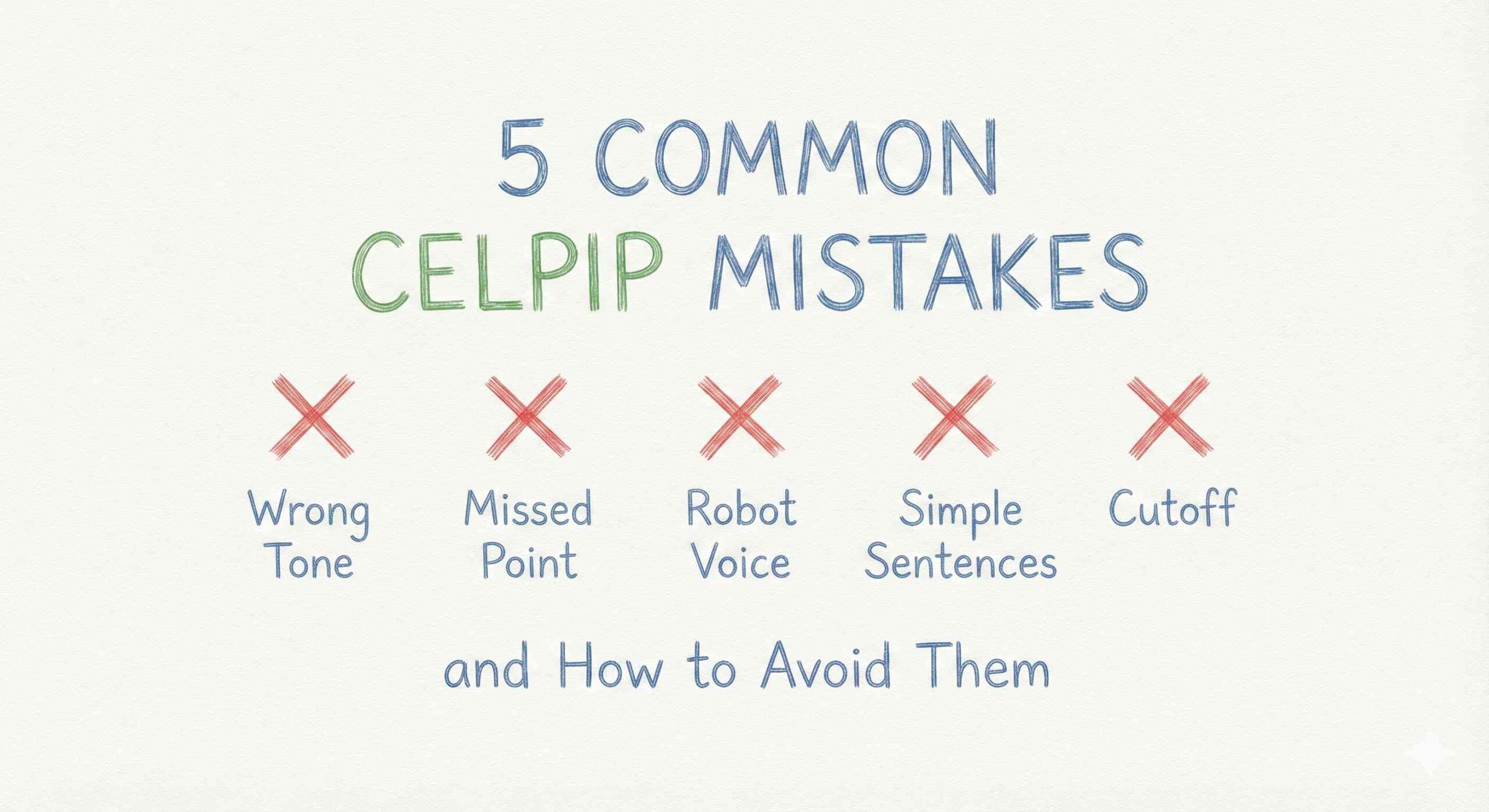
    Below, we list the 5 most common CELPIP mistakes holding your score down, and the simple fixes to help you succeed.

    Mistake #1: Treating CELPIP Like IELTS (The “Tone” Trap)

    This serves as the number one score-killer for people switching from IELTS.

    • The Mistake: Using overly formal, academic language in tasks that require a natural, functional tone.
    • Why It Hurts: CELPIP tests “functional English.” It measures how you speak to a boss, a neighbor, or a friend in Canada. If you write a complaint email to a store manager sounding like a 19th-century professor (e.g., “Furthermore, I implore you to rectify this egregious error”), raters will penalize you for “Tone.”
    • The Fix: Visualize a real person. If the task involves talking to a friend, use contractions (I’m, we’re). Conversely, if speaking to a boss, be polite but direct. Stop trying to impress the rater with big words you do not normally use.

    Mistake #2: Missing a Bullet Point (The “Task Fulfillment” Fail)

    This sounds obvious, yet it happens constantly in Writing Task 1 and Speaking tasks with multiple prompts.

    • The Mistake: Getting so focused on writing a great introduction that you forget to address one of the three required bullet points in the prompt.
    • Why It Hurts: Raters look at “Task Fulfillment” first. If you miss a bullet point, you fail the task criteria. Consequently, your score cap drops immediately, no matter how perfect your grammar is.
    • The Fix: Plan before you write or speak. Tick off each bullet point as you cover it. Never submit an answer without double-checking that you addressed all three points.

    Mistake #3: Sounding Like a Robot (The “Template Zombie”)

    Templates help with structure, but they ruin content if used incorrectly.

    • The Mistake: Memorizing entire sentences from YouTube videos and repeating them word-for-word.
    • Why It Hurts: Raters listen to thousands of tests and know the popular templates by heart. Therefore, if you sound like a scripted robot, they will lower your score for a lack of natural flow.
    • The Fix: Use templates for structure only (e.g., knowing you need an introduction, 2 body paragraphs, and a conclusion). Do NOT memorize full sentences. Instead, practice putting your own ideas into the structure.

    Mistake #4: “Simple Sentence Syndrome”

    To get a CLB 9+, you must demonstrate sentence variety.

    • The Mistake: Writing or speaking in a string of short, simple sentences. “I went to the store. It was closed. I was sad.”
    • Why It Hurts: This demonstrates a “basic” command of the language. Raters prefer complex and compound sentences that connect ideas logically.
    • The Fix: Use transition words and conjunctions. For instance, turn the example above into: “Although I went to the store yesterday, it was unfortunately closed.”

    Mistake #5: The Mid-Sentence Cutoff (Speaking Timing)

    The CELPIP timer is unforgiving.

    The Fix: Practice with a real timer. Learn what 60 seconds feels like. Always have a short “exit phrase” ready to wrap up your answer in the last 5 seconds.

    The Mistake: Trying to say too much and getting cut off by the recording software in the middle of your final sentence.

    Why It Hurts: An incomplete thought makes your answer sound disorganized and lowers your score for “Coherence.”


    H1: 5 Common CELPIP Mistakes That Are Killing Your Score (And How to Fix Them)

    You studied for weeks. You memorized the templates. You felt good on test day. But when the results arrived, you saw a CLB 7 instead of the CLB 9 you needed.

    What happened?

    It’s likely not a lack of English knowledge. It’s a lack of CELPIP strategy. The CELPIP is a unique test, and many smart test-takers fall into the same traps over and over again.

    Here are the 5 most common CELPIP mistakes that are holding your score down, and the simple fixes to get you to the next level.

    H2: Mistake #1: Treating CELPIP Like IELTS (The “Tone” Trap)

    This is the #1 killer of scores for people switching from IELTS.

    • The Mistake: Using overly formal, academic language in tasks that require a natural, functional tone.
    • Why It Hurts: CELPIP tests “functional English”—how you speak to a boss, a neighbor, or a friend in Canada. If you write a complaint email to a store manager sounding like a 19th-century professor (e.g., “Furthermore, I implore you to rectify this egregious error”), you will lose points for “Tone.”
    • The Fix: Imagine a real person. If the task is to talk to a friend, use contractions (I’m, we’re). If it’s to a boss, be polite but direct. Stop trying to impress the rater with big words you don’t normally use.

    H2: Mistake #2: Missing a Bullet Point (The “Task Fulfillment” Fail)

    This sounds obvious, but it happens constantly in Writing Task 1 and Speaking tasks with multiple prompts.

    • The Mistake: Getting so focused on writing a great introduction or using fancy vocabulary that you forget to address one of the three required bullet points in the prompt.
    • Why It Hurts: The first criteria raters look at is “Task Fulfillment.” If you miss a bullet point, you have not fulfilled the task. Your score cap drops immediately, no matter how perfect your grammar is.
    • The Fix: Plan before you write or speak. Tick off each bullet point as you cover it. Never submit an answer without double-checking that all three points are addressed.

    H2: Mistake #3: Sounding Like a Robot (The “Template Zombie”)

    The Mistake: Memorizing entire sentences from YouTube videos and repeating them word-for-word.

    Why It Hurts: In fact, raters listen to thousands of tests and know the popular templates by heart. As a result, if you sound like a scripted robot, they will lower your score for a lack of natural flow.

    The Fix: Use templates for structure only (e.g., knowing you need an introduction, 2 body paragraphs, and a conclusion). Do NOT memorize full sentences. Instead, practice putting your own ideas into the structure.

    H2: Mistake #4: “Simple Sentence Syndrome”

    To get a CLB 9+, you need to show sentence variety.

    • The Mistake: Writing or speaking in a string of short, simple sentences. “I went to the store. It was closed. I was sad.”
    • Why It Hurts: This shows a “basic” command of the language. Raters are looking for complex and compound sentences that connect ideas logically.
    • The Fix: Use transition words and conjunctions. Turn the example above into: “Although I went to the store yesterday, it was unfortunately closed, which was quite frustrating.” (See our post on CELPIP Vocabulary Words for more help with this).

    H2: Mistake #5: The Mid-Sentence Cutoff (Speaking Timing)

    Unfortunately, the CELPIP timer is unforgiving.

    • The Mistake: Trying to say too much and getting cut off by the recording software in the middle of your final, crucial sentence.
    • Why It Hurts: An incomplete thought makes your answer sound disorganized and lowers your score for “Coherence.”
    • The Fix: Practice with a real timer. Learn what 60 seconds feels like. Always have a short “exit phrase” ready to wrap up your answer in the last 5 seconds, like “So, that’s my take on the situation,” or “Anyway, I hope that helps.”

    You Can’t Fix What You Can’t See

    Ultimately, the main problem with these common CELPIP mistakes is that diagnosing them yourself is difficult. First, identifying if your own tone is off takes experience. Second, sounding robotic is often something you do not realize you are doing.

    Consequently, you need an objective, expert ear to listen to you and point these errors out.

    That is exactly what the Smart AI Coach does.

    • Tone Check: The tool flags if your language is too formal or too casual.
    • Completion Check: It analyzes your answer to ensure you hit every part of the prompt.
    • Timing Training: You will be forced to practice under real time pressure so you never get cut off again.

    Stop making the same mistakes over and over. Get the feedback you need to fix them.

    [Diagnose your CELPIP mistakes instantly with Exam Hero.]
  • CELPIP Vocabulary Words: 20+ Words to Boost Your Score to CLB 9

    CELPIP Vocabulary Words: 20+ Words to Boost Your Score to CLB 9

    You have the grammar. You have the ideas. But when you get your score, you are stuck at a CLB 7. What is missing? Often, it’s precision.

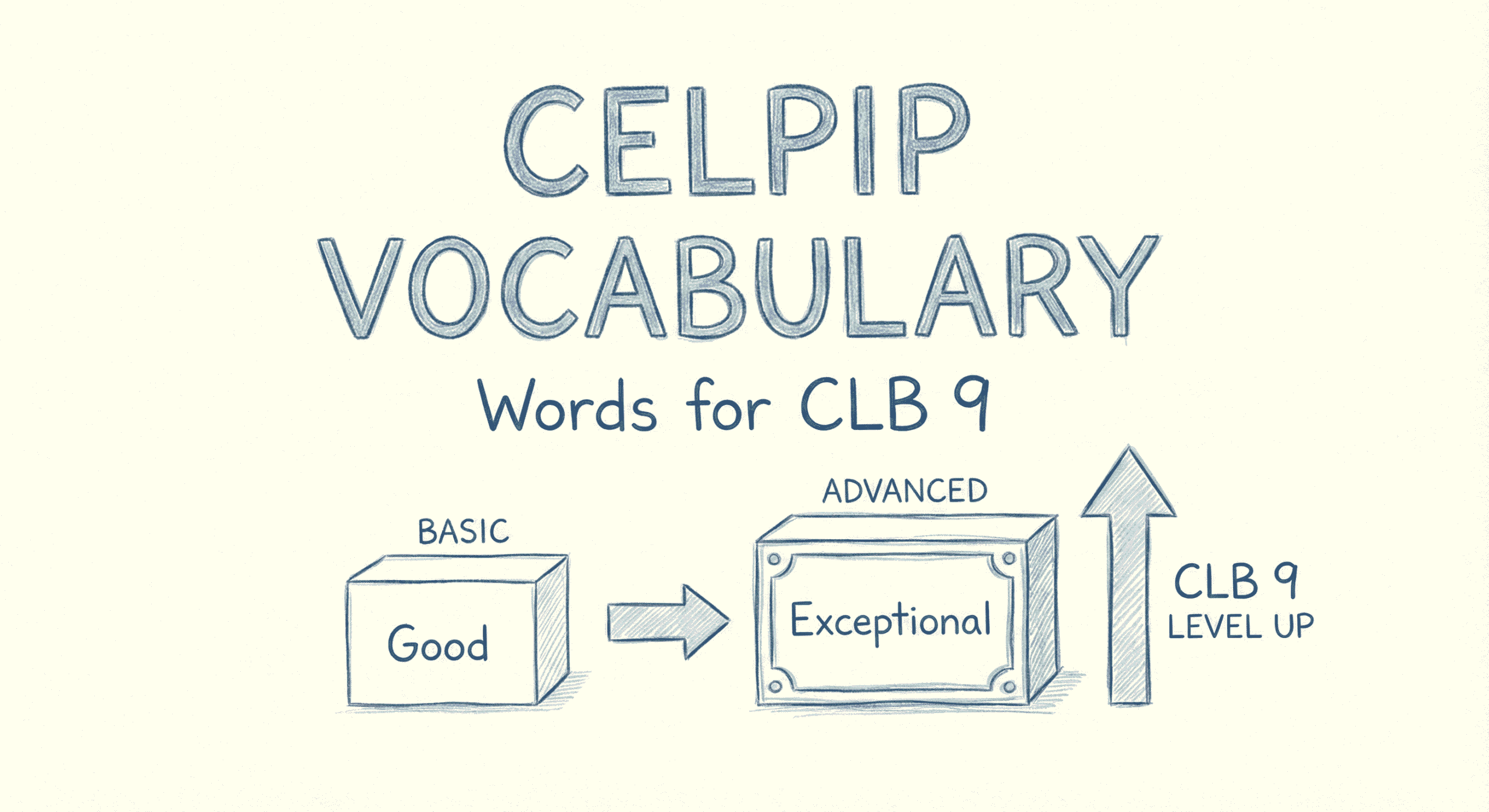
    To jump to a CLB 9+, you need to stop using “basic” English and start using “advanced” CELPIP vocabulary words. This doesn’t mean memorizing a dictionary; it means using specific, high-level words to connect your ideas and express your opinions clearly.

    This guide provides a curated list of essential CELPIP vocabulary words that will instantly upgrade your Speaking and Writing answers.

    Why “Good” and “Bad” Are Killing Your Score

    The raters are looking for “Lexical Resource.” If you describe a party as “good” or a problem as “bad,” you are showing a limited vocabulary.

    To get a high score, you need precise adjectives.

    • Instead of “Good”: Use Exceptional, Beneficial, Advantageous, Breathtaking.
    • Instead of “Bad”: Use Detrimental, Inconvenient, Tedious, Chaotic.
    • Instead of “Big”: Use Substantial, Significant, Extensive.

    Essential CELPIP Vocabulary Words for Transitions

    The “glue” that holds your Speaking and Writing tasks together is your transition vocabulary. These words prove you can organize your thoughts logically.

    1. Adding Information

    Stop using “And” or “Also.”

    • Furthermore: “The library is old. Furthermore, it lacks the space to host community events.”
    • In addition to:In addition to the cost, the location is also inconvenient.”
    • Moreover: “The plan is risky. Moreover, we do not have the budget for it.”

    2. Showing Contrast

    Stop using “But.”

    • However: “I understand your point. However, I believe we need to consider the long-term costs.”
    • Conversely: “Option A is cheaper. Conversely, Option B offers better quality.”
    • On the other hand: “The car is fast. On the other hand, it consumes a lot of gas.”

    3. Giving a Reason or Result

    Stop using “So” or “Because.”

    • Consequently: “It rained heavily all night. Consequently, the event was cancelled.”
    • Due to: “The delay was due to unforeseen traffic.”
    • Therefore: “We are understaffed. Therefore, we cannot accept new clients.”

    Opinion Words for Speaking Task 6 and Writing Task 2

    In these tasks, you must pick a side and defend it. You need strong CELPIP vocabulary words to sound convincing.

    • Crucial / Vital: Better than “important.”
      • Example: “It is crucial that we address this issue immediately.”
    • From my perspective: Better than “I think.”
      • Example:From my perspective, Option A is the superior choice.”
    • Significant: Better than “big.”
      • Example: “This change will have a significant impact on our schedule.”
    • I am convinced that: Better than “I believe.”
      • Example:I am convinced that investing in the new gym is the right decision.”

    The “Big Word” Trap (Warning!)

    There is a danger in memorizing a list of CELPIP vocabulary words. If you use a “fancy” word incorrectly, your score will actually drop.

    Raters hate “forced” vocabulary.

    • Bad Usage: “I have a plethora of sadness.” (This sounds unnatural).
    • Correct Usage: “I am very sad.” or “I am devastated.”

    You cannot just memorize definitions. You must know the context.

    Don’t Just Memorize. Practice in Context.

    Reading this list is easy. Using these CELPIP vocabulary words correctly under the pressure of a 60-second timer is hard.

    If you use “Consequently” when you should have used “Subsequently,” you will confuse the rater. You need feedback on your usage.

    That is why we built the Smart AI Coach.

    • Vocabulary Analysis: Our AI analyzes your Speaking and Writing to see if you are using high-level vocabulary correctly.
    • Synonym Suggestions: If you keep saying “good,” our AI will suggest better alternatives like “beneficial” or “advantageous” instantly.
    • Context Check: We tell you if your fancy words sound natural or forced.

    Stop memorizing lists. Start speaking like a CLB 9

    Upgrade your vocabulary with Exam Hero today.

  • CELPIP Speaking Task 6: Dealing with a Difficult Situation (The CLB 9 Formula)

    CELPIP Speaking Task 6: Dealing with a Difficult Situation (The CLB 9 Formula)

    YYou are asked to tell your boss you can’t work overtime, or tell a neighbor their dog is barking too loudly. Your heart starts racing. How do you say “no” without sounding rude?

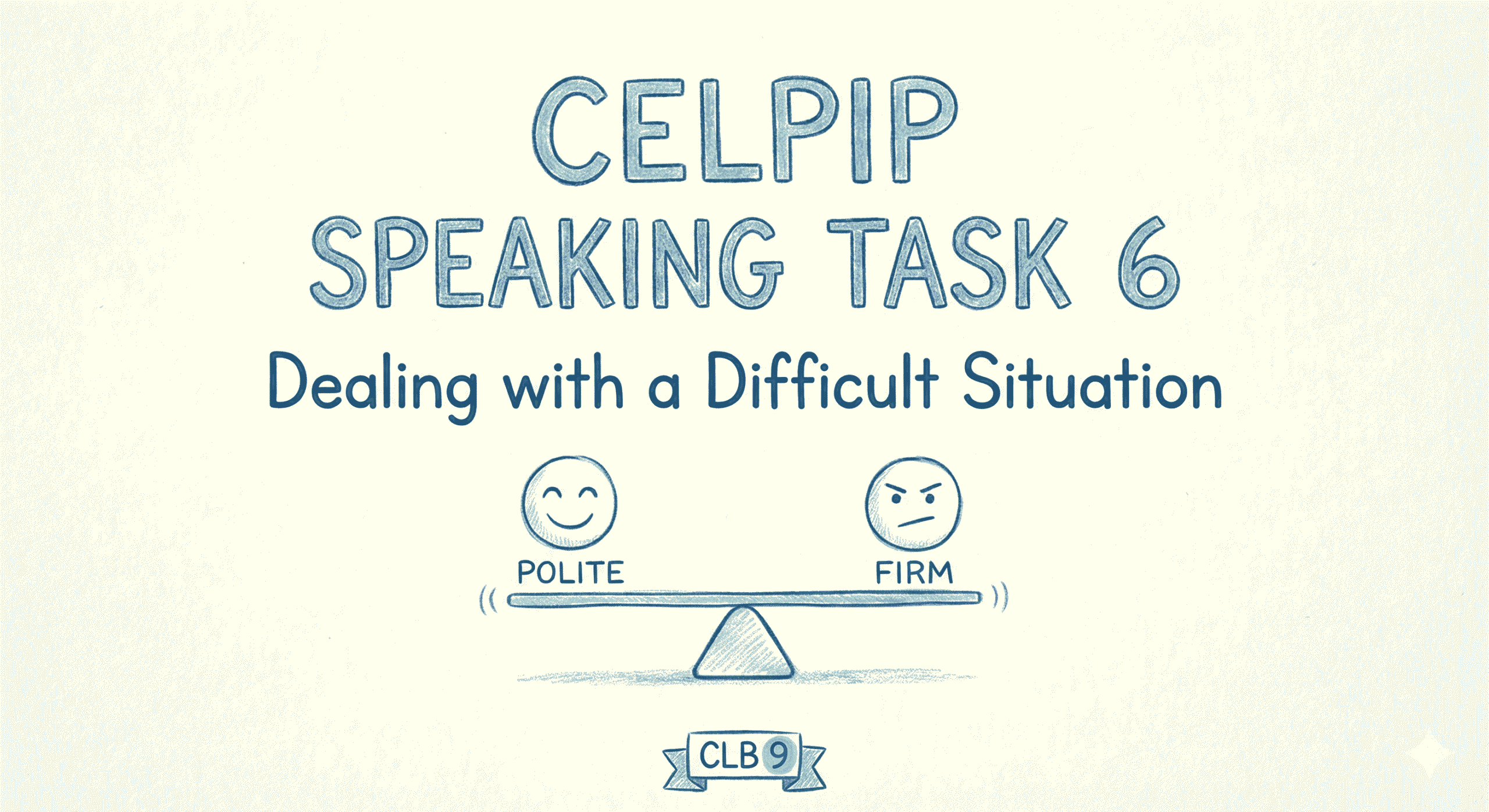
    This is CELPIP Speaking Task 6: Dealing with a Difficult Situation. It is widely considered one of the hardest tasks on the test because it requires a perfect balance of firmness and politeness—all while filling a strictly enforced 60-second timer.

    A robotic, short answer here will get you a CLB 7. To get a CLB 9+, you need to master the art of the “Soft No” and have enough substance to speak for the full minute. This guide gives you the exact formula to do it.

    The Challenge of CELPIP Speaking Task 6

    In CELPIP Speaking Task 6, you are usually placed in a dilemma where you must:

    1. Choose between two options (e.g., talk to your boss OR talk to your co-worker).
    2. Resolve a conflict (e.g., refuse a request or make a complaint).

    The raters are looking for Tone and Development.

    • Too Aggressive: “You need to stop your dog from barking.” (Low Score – Rude)
    • Too Short: “Sorry, I can’t help you, I’m busy. Maybe next time.” (Low Score – Lack of Development)
    • CLB 9+ Balance: A fully developed, minute-long explanation that acknowledges the other person’s feelings while standing firm on your decision.

    The 3-Step Formula for CELPIP Speaking Task 6 (The “B.E.S.” Method)

    Don’t improvise. Use the B.E.S. method to structure your answer every time.

    1. The Buffer (The Soft Opener)

    Never start with “No.” Start with empathy or a positive statement to soften the blow.

    • Example: “Hi John, thanks so much for asking me to help with the project. I really appreciate you trusting me with this.”

    2. The Explanation (The “Why”)

    Give a clear, logical reason why you cannot do what they want. It must be a valid excuse, and you must elaborate on it to fill the time.

    • Example: “However, I have a strict deadline for my own report this Friday, and my manager has made it clear that I cannot take on extra work until it’s finished. If I split my focus now, I risk missing my own targets.”

    3. The Solution (The Compromise)

    This is the money maker. Don’t just leave them with a problem. Offer an alternative solution.

    • Example: “Although I can’t help you this week, I would be happy to review your draft on Monday morning once my deadline has passed.”

    Sample Answer: The “Borrowing Money” Scenario

    Prompt: Your friend asks to borrow $500 for a vacation. You need to refuse because you are saving for a new car.

    CLB 9+ Response (Full 60-Second Answer):

    “Hey Mike, thanks for calling, and thanks for being open with me. I’m really excited to hear you’re planning a trip to Mexico; honestly, it sounds like an amazing break and I know you’ve been working hard for it.” (The Buffer – 10s)

    “I really wish I could help you out with the $500, but to be honest, I’m on a strictly locked-down budget right now. As you know, I’ve been saving every single penny for a down payment on a new car next month. My finances are completely tied up in that goal, and I’m just not in a position to lend out any cash at the moment without putting my own plans at risk.” (The Explanation – 25s)

    “That being said, I don’t want you to miss out. Have you checked out some of the flight deals on ‘TravelNow’? I saw they were offering ‘Buy Now, Pay Later’ payment plans that might make the upfront cost a lot easier to handle. Let me know if you want the link, and we can look at it together!” (The Solution – 20s)

    “Anyway, let me know what you think. Talk soon.” (Sign off – 5s)

    Why This Scores a CLB 9+:

    It Fills the Time: Notice the “padding” phrases (“honestly,” “every single penny,” “completely tied up”). These add natural length.

    Complex Grammar: It uses phrases like “without putting my own plans at risk” rather than just saying “I can’t.”

    Perfect Tone: It is firm about the money but supportive of the friendship.

    Tone is Impossible to Memorize

    You can memorize the “B.E.S.” formula, but you can’t memorize tone.

    You might think you sound polite, but to a Canadian rater, you might sound sarcastic or cold. This is the #1 reason students fail CELPIP Speaking Task 6.

    Reading a blog post won’t fix your voice. You need someone to listen to you.

    That is why we built the Smart AI Coach.

    • Tone Analysis: Our AI listens to your practice answers and flags if you sound “Argumentative,” “Hesitant,” or “Polite.”
    • Timer Discipline: Practice answering hundreds of difficult situations with the real 60-second timer, so you learn exactly how much detail you need to add.

    Don’t let one awkward conversation ruin your immigration score.

    Start practicing Task 6 with Exam Hero today

  • CELPIP Writing Task 1 Complaint Email: A CLB 9+ Template

    CELPIP Writing Task 1 Complaint Email: A CLB 9+ Template

    Nothing is more frustrating than a low score on an “easy” task. For CELPIP Writing Task 1, the complaint email is a common prompt where test-takers lose points.

    Why? They fail to balance a firm, formal tone with a clear request. Or worse, they forget to include all three bullet points from the prompt.

    This guide provides a clear structure and a high-scoring template for any CELPIP Writing Task 1 complaint email.

    What the Raters Are Looking For

    For any CELPIP Writing Task 1 complaint email, the raters are grading you on four things:

    1. Task Fulfillment: Did you include all three bullet points from the prompt?
    2. Tone: Did you sound professional and polite, not angry or rude? (This is a huge one.)
    3. Readability: Is your email easy to read? (Correct paragraph breaks, good transition words).
    4. Vocabulary: Did you use strong, precise words?

    The biggest mistake is focusing too much on vocabulary and forgetting “Task Fulfillment.” If you miss a bullet point, you cannot get a high score.

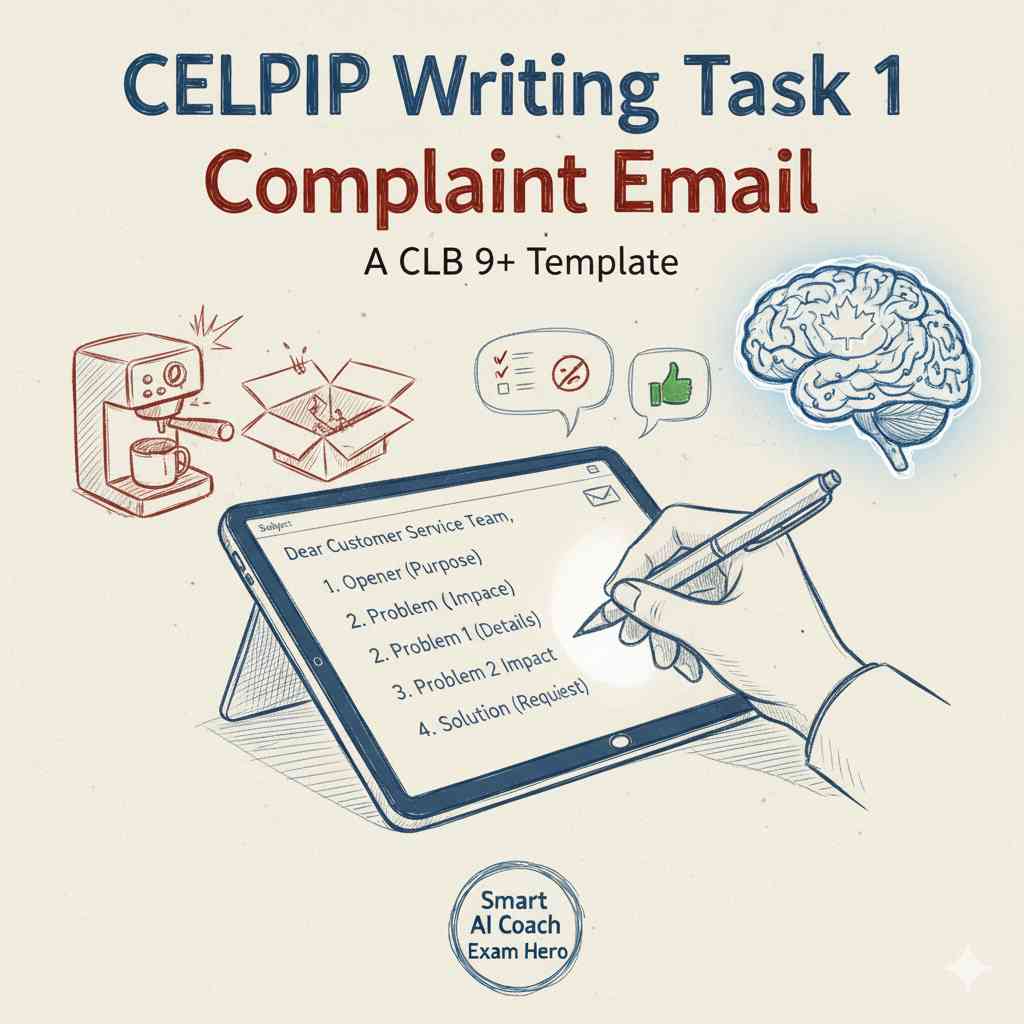
    The 4-Part Structure for a Perfect Complaint Email

    You have 27 minutes. Don’t just start writing. Use the first 2-3 minutes to plan. Follow this simple, 4-paragraph structure to ensure you hit every point.

    • Paragraph 1: The Opener (Context & Purpose)
      • Start with a formal greeting (e.g., “Dear Sir or Madam,” or “Dear M. Jones,”).
      • State why you are writing. Be direct.
    • Paragraph 2: The First Problem (Bullet Point 1)
      • Address the first bullet point from the prompt.
      • Provide one or two specific details.
    • Paragraph 3: The Second Problem (Bullet Point 2)
      • Address the second bullet point.
      • Explain the impact this problem had on you.
    • Paragraph 4: The Solution (Bullet Point 3)
      • Address the final bullet point, which is always your requested solution.
      • State clearly what you expect (e.g., a refund, a replacement, a repair).
      • End with a formal closing (e.g., “I look forward to your response,” or “Thank you for your attention to this matter,”).

    Sample CELPIP Writing Task 1 Complaint Email Template

    Let’s use a common prompt:

    You recently bought a new kitchen appliance (e.g., a coffee maker) from a website. When it arrived, it was not working correctly.

    Write an email to the company’s customer service (150-200 words):

    • Explain when you bought it and what the item is.
    • Describe the problem with the appliance.
    • State what you want the company to do.

    CLB 9+ Sample Answer

    Dear Customer Service Team,

    I am writing to file a formal complaint regarding a “QuickBrew 5000” coffee maker I purchased from your website (order #A45-882) on October 28, 2025. I have been a loyal customer for several years, but this recent experience has been very disappointing.

    The primary issue is that the appliance does not function as advertised. According to the product description, the “one-touch” espresso function is supposed to produce a hot, 2oz shot. Unfortunately, the machine only produces lukewarm water, and the brewing cycle stops after five seconds. Furthermore, the unit arrived with a large, visible crack in the side of the water reservoir.

    This has been a significant inconvenience, as I am now without a coffee maker and have received a damaged, non-functional item.

    To resolve this, I request that you arrange for a pre-paid shipping label so I can return the defective unit. I would like a full replacement sent to my address on file. If a replacement is not possible, I ask for a full refund of $149.99 to my original payment method.

    Thank you for your attention to this matter. I look forward to your prompt response.

    Sincerely,

    Ted J.

    The Missing Piece of Any Template

    Using this template is a great start. But a template only gives you the structure. It doesn’t tell you if your grammar is correct, if your vocabulary is strong, or if your tone is right.

    A template is a map, but you’re still driving the car.

    This is why mastering the core task is so critical. The CELPIP Writing Task 1 complaint email is just one of many types of emails you could be asked to write. To see how to adapt this for other prompts (like asking for information or making a request), you must review the core strategies in our Ultimate Study Guide for CELPIP Writing Task 1: Writing an Email.

    A Template Can’t Give You Feedback. An AI Coach Can.

    Here’s the truth: you can use a perfect template and still get a CLB 7.

    Why? Because you might be making small, repeated errors in grammar, word choice, or punctuation that you don’t even know you’re making.

    You don’t need another template. You need instant, expert feedback.

    This is the exact problem Exam Hero was built to solve. Our Smart AI Coach acts like your personal CELPIP rater.

    • Practice with Our Template: Use the structure you just learned and write your own complaint email in our app.
    • Get Instant Feedback: Within seconds, our AI will score your email. It won’t just give you a number; it will tell you exactly what to fix—from “Task Fulfillment” to “Vocabulary” and “Readability.”

    Stop guessing. Start improving.

    Sign up for Exam Hero today and get instant feedback on your writing.

  • CELPIP vs PTE Core: The 2026 Guide for Canadian Immigration

    CELPIP vs PTE Core: The 2026 Guide for Canadian Immigration

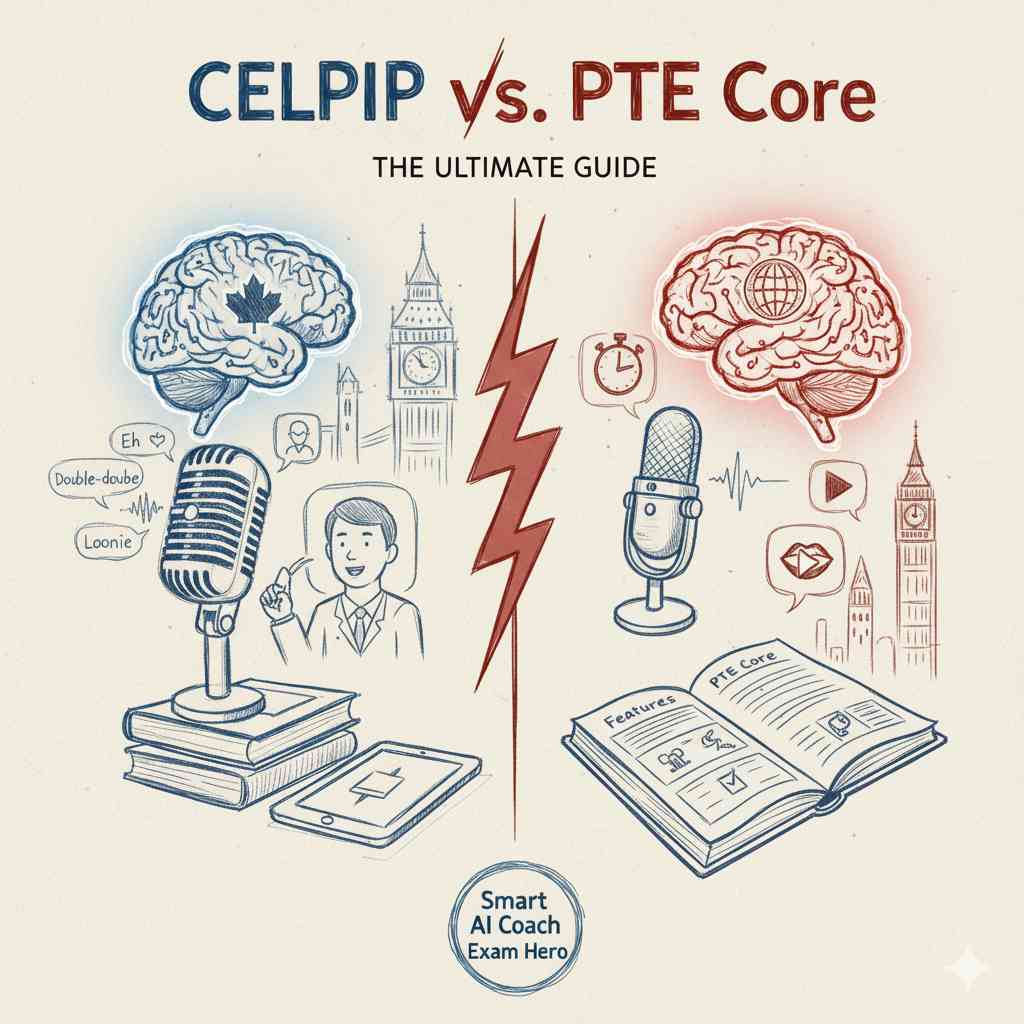
    If you’re applying for Canadian immigration, the game has a new player. IRCC now accepts the PTE Core test, placing it in a direct face-off with Canada’s long-standing champion, the CELPIP. This leaves you with a critical choice: CELPIP vs PTE Core?

    Choosing the wrong test isn’t just a waste of $300; it’s a waste of time and could mean taking a test that’s a bad fit for your skills.

    This guide breaks down the real differences to help you make the right choice.

    What Is the Core Difference? CELPIP vs PTE Core

    The main difference is philosophy.

    • CELPIP (Canadian English Language Proficiency Index Program) is a test about Canada, for Canada. It’s designed to mimic real-life situations you will face, using Canadian accents and practical tasks (like writing an email to a manager or giving advice to a friend).
    • PTE Core (Pearson Test of English) is a 100% AI-scored, fast-paced test of international English. It’s a “global” test that focuses more on your technical ability to repeat, summarize, and describe things quickly, rather than your ability to function in a social or workplace context.

    Both tests are computer-based and accepted by IRCC for permanent residency.

    CELPIP vs PTE Core: Head-to-Head Comparison

    FeatureCELPIP GeneralPTE Core
    Accepted by IRCCYesYes
    Test Duration~3 hours~2 hours
    ScoringHuman & AI Hybrid100% AI Scored
    Accents UsedCanadian OnlyInternational (British, US, Australian)
    Speaking Test8 real-life tasks (e.g., giving advice, describing a scene)7 rapid-fire tasks (e.g., repeat a sentence, read a paragraph)
    Writing TestWriting an email & Responding to a surveySummarizing text & Writing an email
    Results Time3-4 daysTypically 2 days

    The Speaking Test: The Single Biggest Difference

    The speaking sections are night-and-day different. This should be your main deciding factor.

    CELPIP Speaking

    • The Vibe: A practical simulation. You have 8 tasks and 30-90 seconds of preparation time for each.
    • The Tasks: You’ll be asked to do things like: “Give your friend advice about moving to a new city,” or “Describe a picture and make predictions,” or “Deal with a difficult situation with a co-worker.”
    • Who it’s for: This is for the test-taker who is more comfortable with communication than memorization. It feels like a real-world conversation.

    PTE Core Speaking

    • The Vibe: A rapid-fire AI test. You have 7 types of tasks, some with almost no preparation time.
    • The Tasks: The AI wants to know if you can technically speak English. Tasks include: “Read this paragraph aloud,” “Repeat this sentence exactly,” and “Answer this short question in one word.”
    • Who it’s for: This is for the test-taker who is less comfortable “role-playing” and prefers a fast, objective, technical test of their pronunciation and fluency.

    The Writing Test: Survey vs. Summary

    Both tests require you to write an email. The second task, however, is very different.

    • CELPIP Writing Task 2: Responding to a Survey. You are given two options (e.g., a new gym or a new library for your town) and you must choose one and defend your choice. It’s a test of your opinion and your ability to persuade.
    • PTE Core Writing Task 1: Summarize Written Text. You are given a passage and must summarize its main points in one single, grammatically correct sentence. This is a highly academic and technical task.

    If you are a student used to writing academic summaries, PTE Core might be a good fit. If you are more comfortable just giving your opinion in a clear, structured way, CELPIP is the obvious choice.

    What About the “CELPIP vs PTE Core” Difficulty?

    “Easier” is subjective. It depends on your strengths.

    • PTE Core is “easier” if: You have a clear, neutral accent, are great at short-term memorization (for repeating sentences), and prefer a fast, impersonal, 100% AI-scored test. The 2-hour length is also less fatiguing.
    • CELPIP is “easier” if: You are more of a communicator. You’re good at giving advice, telling stories, and expressing opinions. The CELPIP test’s focus on Canadian accents and real-life scenarios makes it far more practical for anyone who has been (or will be) living in Canada.

    Why a “Real-World” Test Matters

    Ultimately, the test you choose should match your goal. Your goal isn’t just to pass a test; it’s to succeed in Canada.

    PTE Core tests your ability to repeat a sentence. CELPIP tests your ability to give your boss an update, handle a complaint from a landlord, or give advice to a new friend.

    One is an academic hurdle. The other is a practical tool.

    This practical focus is why our study guides are so effective. For example, the CELPIP Speaking section always includes a task where you must describe a scene. Mastering this one task is key to a high score. You can learn the exact 4-step structure in our Ultimate Study Guide for CELPIP Speaking Task 3: Describing a Scene.

    You Don’t Need Another Test. You Need a Coach.

    You’ve picked your test. Let’s assume you (smartly) chose CELPIP because you want to practice real Canadian communication.

    Now what?

    Static, “dumb” practice questions simply won’t prepare you for a dynamic, real-world test. You need feedback. More importantly, you need a coach who can listen to you, correct your mistakes, and tell you exactly what the human and AI raters are looking for.

    That’s Exam Hero. We built the Smart AI Coach to give you the one thing you actually need:

    • Instant AI Feedback: Our AI analyzes your Speaking and Writing and gives you a score and detailed feedback, just like the real test.
    • A Proven Strategy: We give you the high-scoring templates for every single task, from giving advice to responding to a survey.
    • A Personalized Plan: Our AI identifies your weaknesses and builds a custom study plan, so you stop wasting time.

    Don’t just prepare for a test. Prepare for your new life in Canada.

    Start Training with the Smart AI Coach Today

  • CELPIP Score Chart: Your Guide to CLB Levels and Immigration

    CELPIP Score Chart: Your Guide to CLB Levels and Immigration

    Understanding the CELPIP Score Chart is the most important step in your Canadian immigration journey. Your CELPIP score isn’t just a number; it’s the key that translates your test performance into a CLB (Canadian Language Benchmark) level.

    Knowing how this conversion works is mandatory. This article breaks down the complete CELPIP Score Chart so you know exactly what score you need to target.

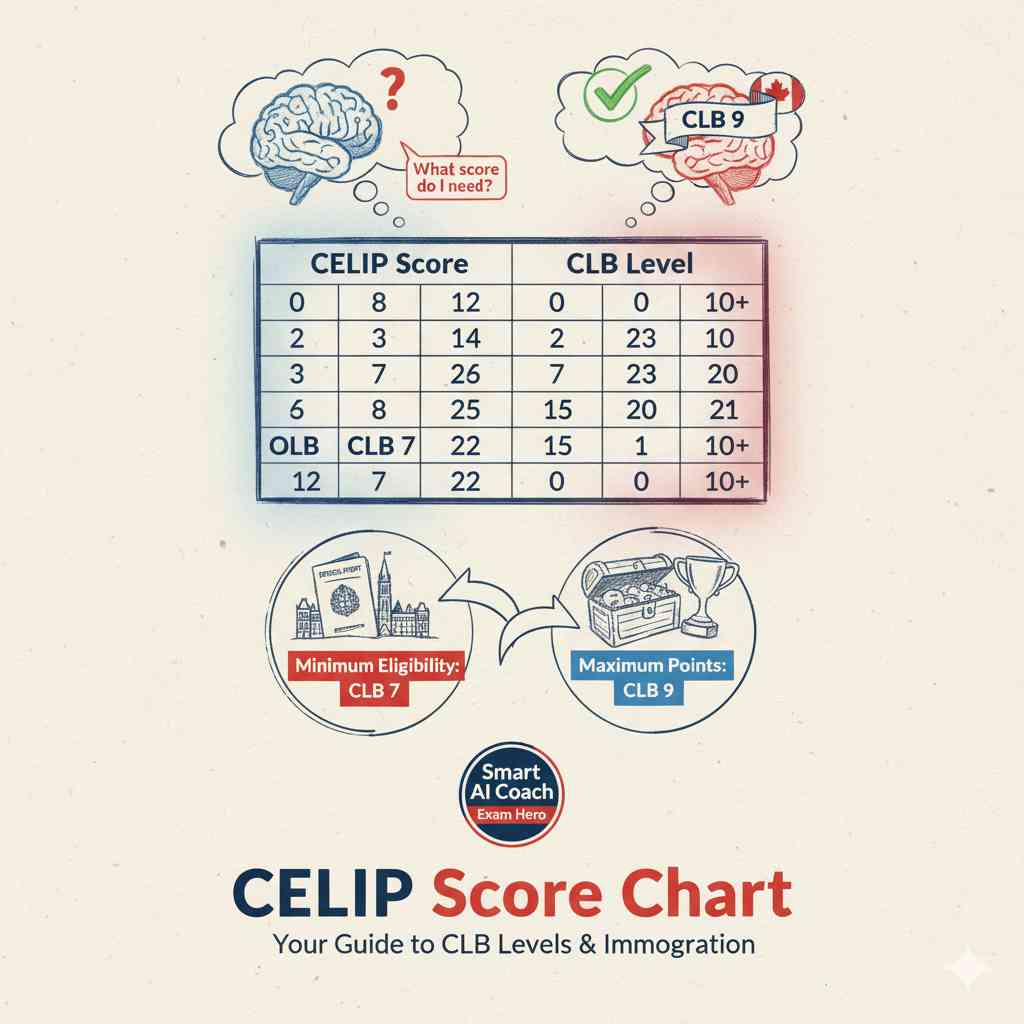
    The Official CELPIP Score Chart (CELPIP to CLB Conversion)

    This is the most important table you need. The CELPIP test is designed to map directly to the CLB levels. For most scores, the conversion is a simple 1-to-1 match.

    Here is the official breakdown:

    CELPIP ScoreCLB LevelProficiency Level
    10-1210+Advanced
    99Effective
    88Good
    77Adequate
    66Developing
    55Acquiring
    44Adequate (for daily tasks)
    33Some proficiency
    0-20-2Minimal / Not Assessed

    Key Takeaway: Notice that a CELPIP score of 9 equals a CLB 9, an 8 equals a CLB 8, and a 7 equals a CLB 7. This makes it easy to know your score. Also, note that getting a CELPIP 10, 11, or 12 all count as “CLB 10+” for immigration purposes.

    Why the CELPIP Score Chart Matters for Express Entry

    our CLB level is not just a score; it’s the key to unlocking points in Canada’s Express Entry system (which manages the Federal Skilled Worker Program).

    There are two “magic numbers” you must know:

    1. The “Magic Number”: CLB 7

    To be eligible for the Federal Skilled Worker Program (FSWP), you must score a minimum of CLB 7 in all four skills (Listening, Reading, Writing, and Speaking). On the CELPIP Score Chart, this means you need a minimum score of 7 in every single section.

    If you get a 9 in Reading, 9 in Listening, 9 in Speaking, but a 6 in Writing, you are not eligible.

    2. The “Golden Number”: CLB 9

    This is where you get the maximum points for language. When you hit CLB 9 in all four skills, your Comprehensive Ranking System (CRS) score for language jumps dramatically.

    For most applicants, achieving a “CLB 9” (a CELPIP 9 in all four sections) is the primary goal for being competitive in the Express Entry pool.

    What Holds Most People Back from a CLB 9?

    t’s common to see a CELPIP Score Chart with high scores in Reading and Listening but a frustrating 7 or 8 in the Writing section. Why?

    The Writing section is not just about grammar; it’s about Task Fulfillment. Raters use a strict checklist. If you fail to address every part of the prompt, your score drops, no matter how good your vocabulary is.

    For example, in Writing Task 2, you are asked to choose between two options. A high-scoring answer requires you to clearly state your choice, provide strong supporting reasons for it, and acknowledge the other option. Missing any of those steps will prevent you from getting a CLB 9.

    To see the exact formula for this task, you can review our Ultimate Study Guide for CELPIP Writing Task 2: Responding to a Survey.

    Stop Guessing Your Score. Get Real Feedback.

    Looking at a CELPIP Score Chart tells you your destination. It doesn’t tell you how to get there.

    You can do 20 practice tests and still have no idea why you’re stuck at a CLB 8 in Speaking. You’re just practicing your mistakes. To improve, you don’t need more tests, you need a coach.

    This is exactly why we built Exam Hero. We don’t just give you practice; we give you a Smart AI Coach.

    • Instant AI Feedback: Our AI acts like a real rater, giving you detailed feedback on your Speaking and Writing. It will tell you exactly why you lost points on “Task Fulfillment” or “Listenability.”
    • Personalized Study Plan: Our system finds your weak spots and builds a custom study plan to fix them. Stop wasting time on the sections you’ve already mastered.

    Stop practicing in the dark. Know your score before you walk into the test.

    Start Your AI-Powered Study Plan Today

  • CELPIP Results Time: How Long to Wait for Your Score

    CELPIP Results Time: How Long to Wait for Your Score

    The test is over. You’ve walked out of the exam room, relieved but also buzzing with anticipation. Now, the agonizing wait begins. The top question on your mind is, “What is the CELPIP results time?”

    This is one of the most common questions test-takers have. Understanding the CELPIP results time is crucial, especially if you’re up against an immigration deadline.

    This guide will give you the exact timelines for your CELPIP General and CELPIP General LS test results, and what to do while you wait.

    Understanding the Official CELPIP Results Time

    Paragon Testing Enterprises, the creators of CELPIP, provides a clear timeline for score release.

    For both the CELPIP General Test and the CELPIP General LS Test:

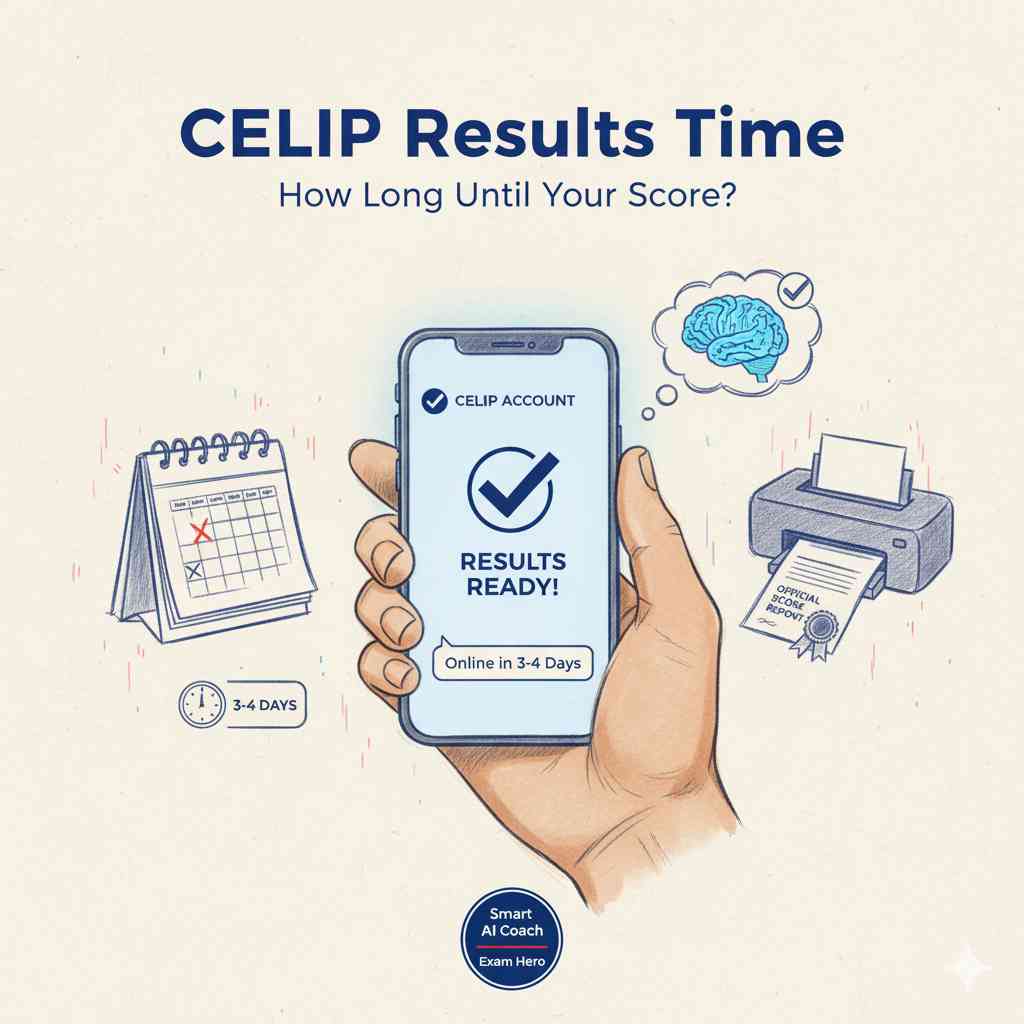
    • Online Release: Your scores are typically available online through your CELPIP account within 3 to 4 calendar days after your test date.
    • Official Hard Copy (Optional): If you ordered a hard copy of your Official Score Report, it will be mailed via regular post after your online results are released. Delivery times will vary based on your location.

    What Does “3 to 4 Calendar Days” Really Mean?

    Let’s clarify with an example:

    • Test Date: Saturday, October 21st
    • Day 1: Sunday, October 22nd
    • Day 2: Monday, October 23rd
    • Day 3: Tuesday, October 24th
    • Day 4: Wednesday, October 25th

    In this example, your scores would likely be available online by Tuesday, October 24th or Wednesday, October 25th at the latest.

    Remember, “calendar days” include weekends and holidays.

    Urgent Results: The Express Rating Option

    Are you in a rush? CELPIP offers an Express Rating option.

    • Cost: An additional $80 CAD (plus tax).
    • Timeline: Your results will be available online within 1 to 2 calendar days after your test date.

    You can select the Express Rating option when you register for your test, or you can add it to your existing test registration before your test date.

    How to Access Your CELPIP Scores

    Once your scores are released, accessing them is straightforward:

    1. Log in to Your CELPIP Account: Go to the official CELPIP website (celpip.ca) and log in using your registered username and password.
    2. Navigate to “View Scores”: You’ll find a section or tab dedicated to your test results.
    3. Download/Print: Your Official Score Report will be available for download as a PDF. You can print this for your records or share it electronically if required.

    The online version is generally all you need for immigration applications.

    What to Do While You Wait for Your Scores

    The waiting period can be stressful, but it’s a perfect time to tie up any loose ends for your immigration application or future study plans.

    • Review IRCC Requirements: Double-check the specific CLB (Canadian Language Benchmark) levels required for your particular immigration program.
    • Gather Other Documents: Use this time to organize other documents needed for your application.
    • Relax! You’ve done your part. Try to distract yourself with other activities.

    Understanding Your CLB Scores

    Your CELPIP scores correspond to the Canadian Language Benchmarks (CLB). Each section (Listening, Reading, Writing, Speaking) is given a score from 1 to 12. Understanding how these translate to CLB levels is vital for your immigration application.

    To get a complete overview of how CELPIP scores map to CLB levels and what score you’ll need for Express Entry, Provincial Nominee Programs, and other immigration streams, consult our Comprehensive CELPIP Score Chart Study Guide. It breaks down exactly what each CLB level means and how it impacts your eligibility.

    Don’t Just Wait. Prepare Proactively for Your Next Steps.

    Waiting for scores is one thing. Waiting for scores and not knowing what to do if they’re not high enough is another.

    Many test-takers assume they just need “more practice” if their scores aren’t what they hoped for. But endless practice without targeted feedback is just practicing your mistakes.

    At Exam Hero, we believe in proactive preparation, not just reactive waiting.

    Our Smart AI Coach is designed to eliminate the guesswork from your CELPIP journey:

    • Instant Feedback: Get immediate, detailed analysis on your Speaking and Writing tasks, showing you exactly where you lost points.
    • Personalized Plan: Our AI-powered study plan adapts to your weaknesses, ensuring every minute you spend studying is productive.
    • Master Every Task: Learn the proven strategies and structures for every CELPIP section, so you approach the test with confidence.

    Stop waiting anxiously and start preparing intelligently. Get the feedback you need before you even take the test, and walk into the exam room knowing you’re ready.

    Sign up for Exam Hero today and secure your target score.

  • CELPIP Re-evaluation: Is It Worth the $55 Gamble?

    CELPIP Re-evaluation: Is It Worth the $55 Gamble?

    That gut-sinking feeling. Your CELPIP scores pop up, and you’ve hit a 10 in Listening, a 12 in Reading… and an 8 in Writing. But you needed a 9.

    Your first thought: “This has to be a mistake. I know I did better than that.” Your second thought: “Should I pay for a re-evaluation?”

    It’s a common dilemma. You’re weighing the cost, the risk, and the chance that a different rater might give you the score you need. This guide will give you the definitive answer.

    The 3 “Must-Know” Facts About Re-evaluation

    Before you decide, let’s clear up the facts.

    1. Which sections can be re-evaluated?

    You can only request a re-evaluation for the Speaking and Writing sections.

    Why? The Listening and Reading sections are marked by a computer. The answers are either right or wrong. Barring a system-wide glitch, that score is final.

    Speaking and Writing, however, are scored by human raters. This introduces subjectivity. A different senior rater (who conducts the re-evaluation) may have a different opinion of your performance.

    2. The Big Myth: Can my score go down?

    NO. This is the most important rule.

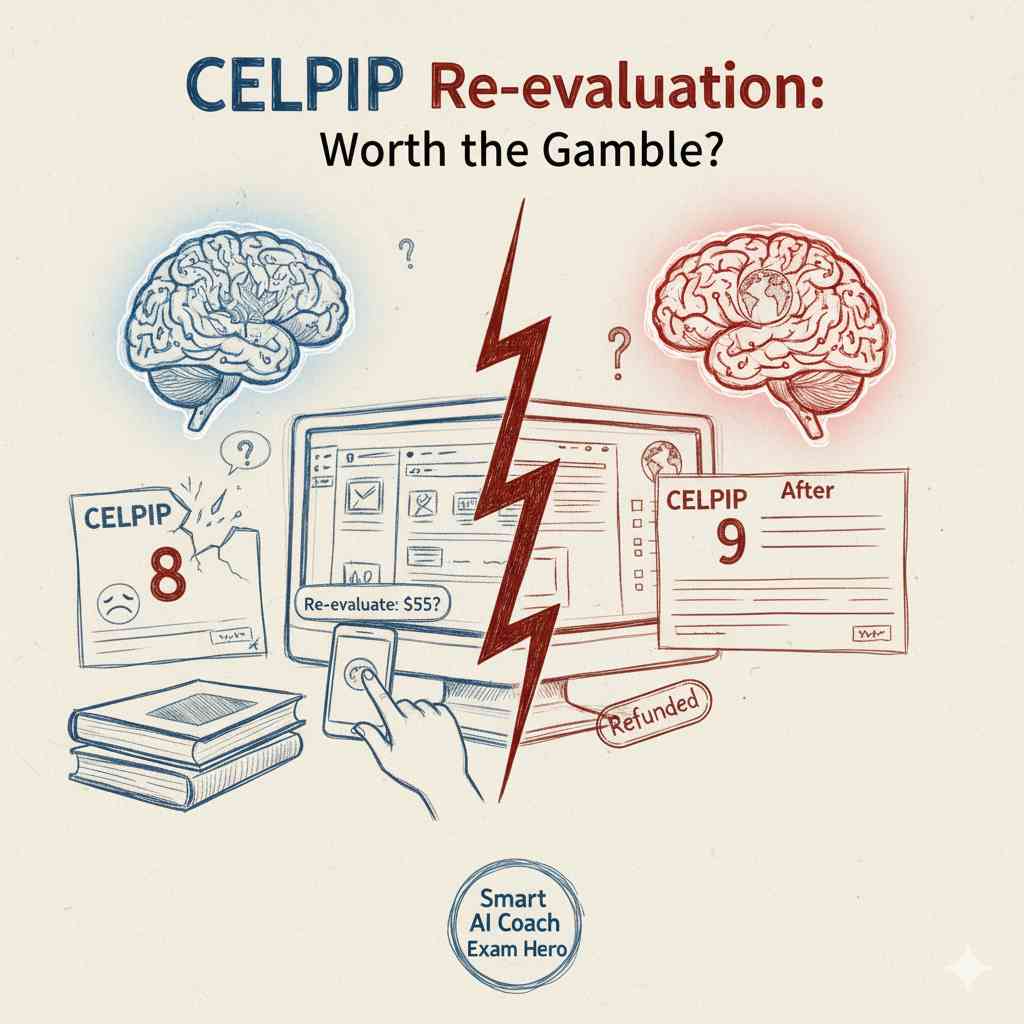
    Your score can only go up or stay the same. If the senior rater assigns a lower score than your original, your original score stands. There is zero risk of losing the points you already have.

    3. What does it cost?

    A re-evaluation costs $55 CAD (plus tax) per section.

    • Want just your Writing re-evaluated? $55.
    • Want both Writing and Speaking? $110.

    Here’s the best part: If your score on a section changes (i.e., goes up), the $55 fee for that section is fully refunded to you.

    You can apply for a re-evaluation any time within 6 months of your test date through your main CELPIP account.

    So… Is It Worth It? (Which Section Should You Re-evaluate?)

    This is where strategy comes in. “Worth it” depends on two things: the section itself and how you know you performed.

    Re-evaluating Speaking

    The Speaking section is often considered the most subjective. Raters are listening for tone, clarity, and task fulfillment under a tight clock. It’s absolutely possible that a second rater could be more favorable.

    You SHOULD consider it if:

    • You are 100% confident you spoke clearly and your ideas were well-organized.
    • You finished all 8 tasks on time.
    • You are just one CLB level short (e.g., you got an 8 but need a 9).

    You should NOT consider it if:

    • You know you mumbled or spoke too quietly.
    • You completely froze or ran out of time on a task.
    • You need a huge jump (e.g., from a 6 to a 9).

    Re-evaluating Writing

    Writing is also subjective, but a little less so than Speaking. Raters use a very specific checklist. Did you meet the word count? Did you address all the prompts? Is your grammar and vocabulary strong?

    You SHOULD consider it if:

    • You are positive you addressed every single bullet point in the prompt.
    • You met the word count for both tasks.
    • Your spelling and grammar were strong, and you used good transition words.

    You should NOT consider it if:

    • You know you missed one of the prompts in Task 1 or Task 2.
    • You were significantly under the word count.
    • You ran out of time and your conclusion was just one short-off sentence.

    The Real Reason You Get a Low Score

    A low score in the subjective sections (Speaking and Writing) is rarely a “bad rater.” It’s almost always a sign that the structure of the answer was weak.

    Test-takers lose the most points in Writing Task 1 because they fail to follow the instructions. They might write a beautiful email but forget to address one of the three required prompts, resulting in an automatic low score for “Task Fulfillment.”

    A re-evaluation won’t save you if the core task wasn’t completed. The first step is to master the formula.

    Don’t Gamble on a Re-evaluation. Guarantee Your Score Instead.

    A re-evaluation is a $55 gamble. You’re betting that maybe a different rater will see things differently. It’s a reactive solution to a problem that already happened.

    A much better approach is to be proactive.

    How can you guarantee your score before you pay for the test? You need feedback. But you can’t get feedback from a static practice test.

    This is exactly why we built Exam Hero. We’re not another test library; we are a Smart AI Coach.

    • Stop Guessing: Our AI acts like a senior rater. It gives you instant, detailed feedback on every Speaking and Writing task you submit.
    • Know Your Weaknesses: The AI will tell you exactly why you’re losing points—whether it’s “Task Fulfillment,” “Vocabulary,” or “Listenability.”
    • Get a Custom Plan: Our system analyzes your performance and builds an AI-powered study plan focused on your specific weak spots.

    Why gamble $55 on a re-evaluation when you can guarantee your score the first time? Stop practicing in the dark.

    Sign up for Exam Hero today and get your target score with our Smart AI Coach.

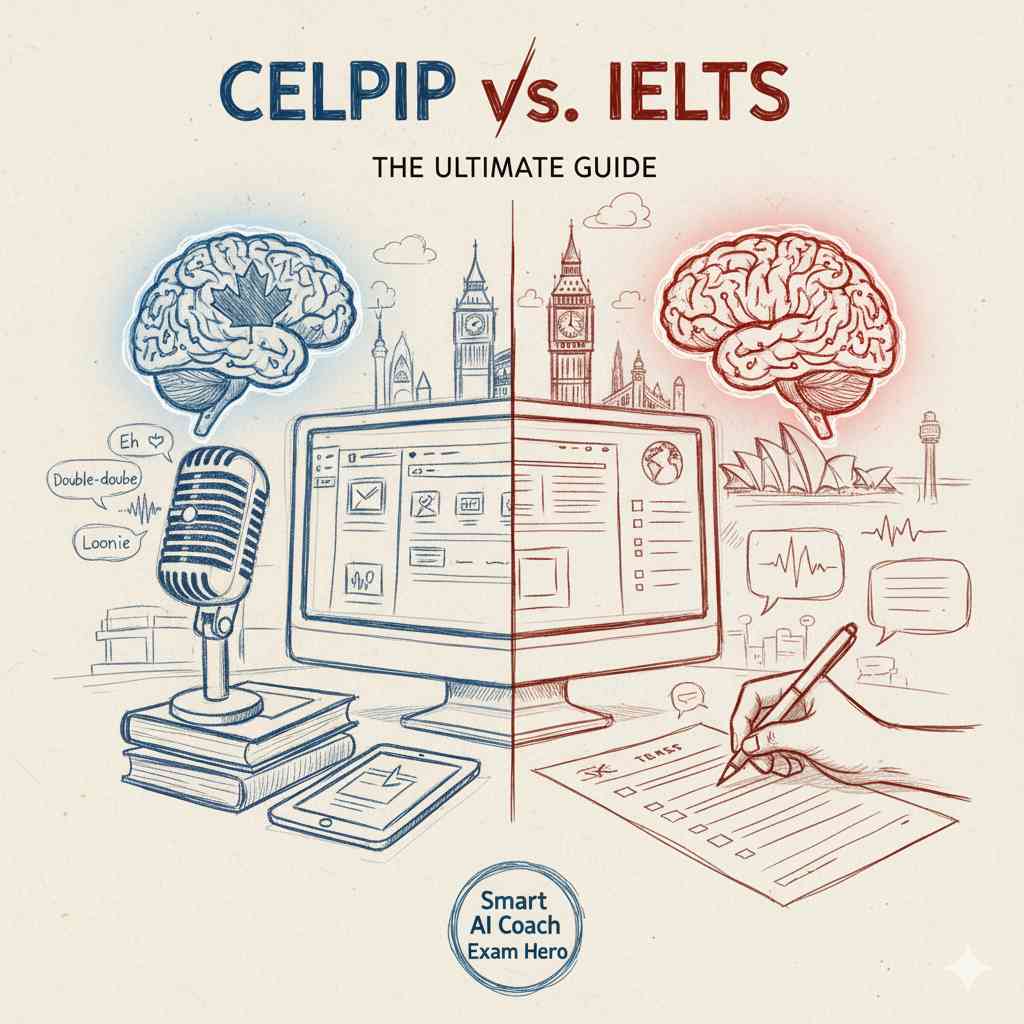
  • CELPIP vs IELTS: The Ultimate Guide for Canadian Immigration

    CELPIP vs IELTS: The Ultimate Guide for Canadian Immigration

    If you’re applying for Canadian immigration, you know you need to prove your English proficiency. This brings you to the big question: CELPIP or IELTS?

    Both are accepted by Immigration, Refugees and Citizenship Canada (IRCC), but they are fundamentally different tests. Choosing the wrong one can be a costly, time-consuming mistake.

    This guide breaks down exactly what you need to know to choose the right test for you.

    What’s the Core Difference?

    CELPIP (Canadian English Language Proficiency Index Program): This test is made by Canadians, for Canada. It’s a single, 3-hour, 100% computer-based test that uses Canadian accents and real-world scenarios.

    IELTS (International English Language Testing System): This is the global standard. It’s used for immigration and study in the UK, Australia, New Zealand, and Canada. It uses a mix of international accents (British, Australian, American) and comes in two formats: paper-based or computer-based.

    For Canadian immigration, you must take the CELPIP General Test or the IELTS General Training test.

    CELPIP vs. IELTS: A Head-to-Head Comparison

    The best way to decide is to compare the four sections directly.

    FeatureCELPIP GeneralIELTS General Training
    Accepted by IRCCYesYes
    Test Format100% computer-basedComputer-based OR Paper-based
    Accents UsedCanadian onlyInternational (British, Australian, etc.)
    Speaking TestRecorded into a microphoneFace-to-face with a live examiner
    Test Length~3 hours (all in one sitting)~2 hours 45 mins (Speaking often on a different day)
    Results Time3-8 days3-5 days (computer) / 13 days (paper)

    A Deeper Look: Speaking Section

    This is the most significant difference and the #1 factor for most test-takers.

    CELPIP Speaking

    • How it works: You read prompts on a computer screen and record your answers into a microphone. There is no human in the room.
    • The Tasks: You are given 8 tasks that mimic real-life situations, such as giving advice to a friend, describing a scene from a picture, or expressing an opinion.
    • Who it’s for: This format is ideal if you get nervous speaking to a live person. You can focus just on the screen and your answer.

    IELTS Speaking

    • How it works: You sit in a room (or on a video call) with a live, certified examiner. It feels like a structured, formal interview.
    • The Tasks: The test has 3 parts: an introduction and interview, a “long turn” where you speak on a topic for 1-2 minutes, and a follow-up discussion.
    • Who it’s for: This format is better if you are a confident speaker who prefers a natural, human conversation and finds talking to a computer awkward.

    A Deeper Look: Writing, Reading, and Listening

    Writing

    • CELPIP: 100% typed. The two tasks are practical: Writing an Email (Task 1) and Responding to a Survey (Task 2). This is great for fast typists.
    • IELTS: You either type (computer-based) or handwrite (paper-based). The tasks are more academic: writing a letter (Task 1) and writing an essay (Task 2). If you have slow or messy typing skills, the paper-based option is a huge advantage.

    Reading

    • CELPIP: All questions are computer-based multiple-choice (using a drop-down menu). This means spelling is not a risk.
    • IELTS: Features a wider variety of question types, including “fill-in-the-blanks,” matching, and True/False/Not Given. Spelling counts on your answers.

    Listening

    • CELPIP: Uses only Canadian accents and multiple-choice questions. You cannot go back and review your answers once you’ve moved on.
    • IELTS: Uses a mix of international accents. You get a variety of question types (like in the Reading section), and you have time at the end to review and transfer your answers.

    The CELPIP test is not just about grammar; it’s about functional communication. For example, in the Speaking section, you’re not just asked random questions, you’re put in a specific scenario.

    Two of the most common tasks are Speaking Task 3: Describing a Scene and Speaking Task 4: Making Predictions about that same scene. You are graded on your ability to use specific vocabulary, structure your answer logically, and speak clearly under pressure.

    Just practicing is not enough. You need a strategy for exactly what to say.

    To master this, you need a proven method. Start by reviewing our Ultimate Study Guide for CELPIP Speaking Task 3: Describing a Scene. It breaks down the exact structure you need to get a high score.

    The Verdict: Which One Should You Take?

    You should choose CELPIP if:

    • You are a fast and comfortable typist.
    • You get very nervous speaking to a live examiner.
    • You are more comfortable with North American accents only.
    • You want your entire test done in one single appointment.

    You should choose IELTS if:

    • You prefer a natural, face-to-face conversation with a real person.
    • Your typing is slow, and you prefer to handwrite your essays.
    • You are confident in your spelling.
    • You want a test that is also accepted in other countries (like the UK).

    How to Stop Practicing and Start Improving

    Now you know which test to take. The next question is how to prepare.

    The most common mistake is wasting months on “static practice”, doing endless mock tests from a book or a simple test library and just hoping your score gets better.

    But think about it: If you don’t know why your Speaking task is scoring a CLB 7, how can you ever get a 9? When you just do tests without feedback, you are only practicing your mistakes.

    To improve a skill, you need feedback. Not just more practice.

    This is where Exam Hero is different. We didn’t build another test library; we built a Smart AI Coach.

    • Stop Guessing: Our AI provides instant, detailed feedback on your Speaking and Writing. It doesn’t just give you a score; it tells you what to fix and how to fix it.
    • Stop Wasting Time: Our AI-powered Study Plan analyzes your weaknesses and creates a custom roadmap, so you only study what you actually need to.
    • Get Proven Strategies: Learn the high-scoring structures for every single CELPIP task, so you can answer with confidence every time.

    Don’t just practice in the dark. Start training with a “Smart AI Coach” and get your target score, faster.

    Sign up for Exam Hero today and unlock your personalized study plan.