You look at the timer. You have been talking for what feels like an hour. You check the screen: only 45 seconds have passed. You still have 45 seconds left.
Suddenly, panic sets in. You repeat your last point. You say “um” and “ah.” You drift into awkward silence.
Unfortunately, this is the most common way students lose points on CELPIP Speaking Task 7.
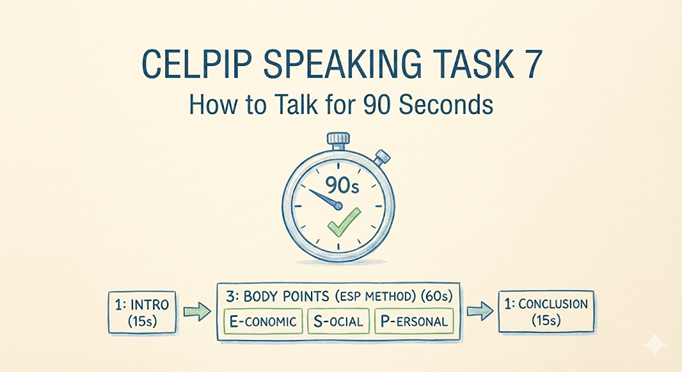
Unlike the other tasks, which are 60 seconds, Task 7 requires you to speak for a full 90 seconds on a complex opinion topic. To survive this marathon, you don’t need more vocabulary; you need more structure.
Below is the detailed “1-3-1 Blueprint,” a proven formula that will help you fill the time with high-quality content every single time.
The Challenge: Why 90 Seconds is So Hard
First, we must accept that 90 seconds is an eternity in exam time. Most people run out of ideas after 45 seconds.
Specifically, the trap is “going deep” on just one point. If you spend 60 seconds talking about one reason, you will repeat yourself and sound disorganized.
Therefore, the secret is not to dig a deep hole, but to dig three separate holes. You need width, not just depth.
How to Use Your 30 Seconds of Prep (The “ESP” Trick)
Before you speak, you have 30 seconds to think. Do not waste this staring at the screen.
Instead, use the “ESP” Method to instantly generate three distinct arguments:
- E – Economic: Does this save money, make money, or affect the economy?
- S – Social: How does this affect people, families, or relationships?
- P – Personal/Physical: How does this affect health, mental state, or daily life?
Consequently, when the timer starts, you already have your three body paragraphs ready to go.
The “1-3-1” Blueprint in Action
Next, let’s look at a real example. Prompt: Do you think remote work should become permanent for all companies?
Using the “1-3-1” structure (1 Intro, 3 Points, 1 Conclusion), here is how a CLB 9 answer looks.
1. The Intro (10-15s)
Start with a clear hook and your definitive opinion.
- “That is a highly debated topic in today’s workforce. Personally, I strongly advocate for remote work becoming the new standard for most businesses.”
2. Point 1: Economic (20s)
First, tackle the money aspect.
- “First of all, from an economic perspective, remote work saves massive amounts of money for both employers and employees. Companies can reduce their office rent, while workers save on gas and commuting costs.”
3. Point 2: Social/Mental Health (20s)
Secondly, move to the human aspect.
- “Secondly, looking at the social benefits, working from home allows for a much healthier work-life balance. Parents can spend more time with their children, which leads to happier, more productive employees.”
4. Point 3: The “Concession” (20s)
Crucially, use your third point to address the opposition. This fills time and shows critical thinking.
- “Admittedly, some critics argue that remote work destroys team culture. However, I believe that with modern video tools like Zoom, we can maintain strong connections without being in the same room.”
5. The Conclusion (10-15s)
Finally, wrap it up smoothly.
- “For these reasons—financial savings, better mental health, and modern technology—I am convinced that remote work is the future.”
Emergency Tactics: What If I Freeze?
Admittedly, even with a plan, you might freeze at the 70-second mark. What then?
Don’t panic. Use the “Personal Story” Eject Button.
If you run out of general arguments, instantly switch to a personal example.
- “For instance, my own brother started working remotely last year, and I have seen how much his stress levels have dropped…”
This tactic is a lifesaver. It is easy to talk about yourself, and it naturally fills 15-20 seconds.
Why You Need Realistic Practice
Undoubtedly, reading this script is easier than speaking it.
You need to feel the internal clock. You need to know exactly when to switch from Point 1 to Point 2 without looking at a stopwatch.
Ultimately, this is why Exam Hero is essential for Task 7.
- The “ESP” Drills: We give you random topics and force you to brainstorm Economic, Social, and Personal points in 30 seconds.
- Stamina Training: Our AI Timer simulates the pressure. If you stop talking at 60 seconds, you fail the drill.
- Flow Analysis: We analyze your transition words. Did you use “First,” “Secondly,” and “However”? If not, we tell you immediately.