A complex image appears on the screen. It’s a busy park with twenty different people doing twenty different things. A timer counts down. You have 60 seconds to describe it to someone who can’t see it.
Suddenly, your mind goes blank. You start listing random objects: “I see a dog. I see a tree. There is a man.”
Unfortunately, randomly listing objects is the fastest way to get stuck at a CLB 6.
Undoubtedly, CELPIP Speaking Tasks 3 & 4 are unique challenges. They don’t just test your fluency; they test your ability to organize visual information (Task 3) and use advanced future grammar (Task 4).
To hit CLB 9+, you need more than just “good English.” You need a tactical plan. Below is the comprehensive guide to the “Spiral Method” for describing and the “Crystal Ball Technique” for predicting.
The Challenge: Getting Lost in the Picture
First, we need to fix your eye movement. The images in Task 3 are intentionally cluttered. They want you to get distracted.
Consequently, if you don’t have a plan, your eyes dart around randomly. You describe a bird in the sky, then a shoe on the ground, then a building in the back. This confuses the listener.
Therefore, you need a “mental map” to guide your description logically.
Task 3 Strategy: The “Spiral Method”
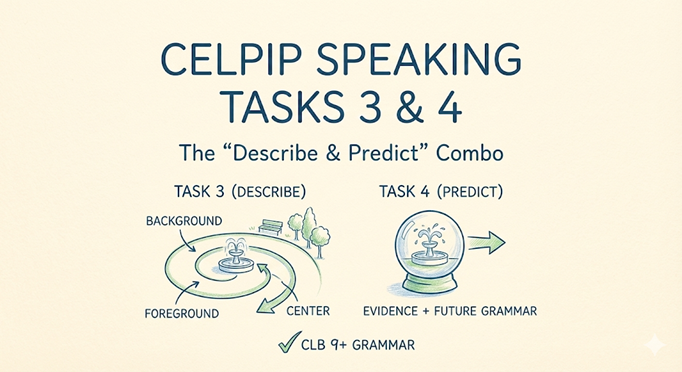
Next, stop jumping around. Use the “Spiral Method” to organize your answer. Imagine a spiral starting from the center of the picture and winding outward.
- The Center (The Anchor): Start with the most obvious action in the middle. This grounds the listener.
- The Foreground (The Details): Move to the specific details closest to “camera.”
- The Background (The Setting): End with the scenery, weather, or buildings in the distance.
The “Spiral” in Action (Sample: A Busy Park Scene)
- Center: “In the center of the scene, there is a large fountain where several children are splashing water.”
- Spiral Out (Foreground): “Moving to the immediate foreground, a woman is sitting on a bench reading a newspaper, oblivious to the noise.”
- Spiral Out (Background): “Finally, in the background, storm clouds are gathering over the city skyline, suggesting rain is imminent.”
The “Preposition Cheat Sheet” (Vocabulary Upgrade)
Furthermore, you cannot score a CLB 9 if you only use “next to” or “on the left.” You need precise spatial vocabulary.
Memorize these upgrades:
| Basic Level (Avoid) | Advanced Level (Use This) |
| “On the left” | “On the left-hand side of the image…“ |
| “In the front” | “In the immediate foreground…“ |
| “In the back” | “In the far background…“ |
| “Next to” | “Directly adjacent to…“ |
| “Between” | “Sandwiched between…“ |
Task 4 Strategy: The “Crystal Ball” Technique
After describing the scene, the test asks you to predict what will happen next based on the same picture.
Admittedly, you cannot see the future. However, the test isn’t asking for wild guesses. It is asking for evidence-based predictions.
Specifically, look for “incomplete actions.”
- Evidence: A waiter is tripping over a rug while holding a tray.
- Prediction: He is going to drop the food.
Level 6 vs. Level 9 Predictions (Grammar Check)
Finally, the difference between a CLB 6 and a CLB 9 is your grammar variety. Do not just use “will” for every sentence.
The “Will” Trap (CLB 6)
“The waiter will fall. The food will go everywhere. The customer will be mad.” (This is repetitive and robotic).
The “Advanced Future” Flow (CLB 9)
“Based on his posture, it appears highly likely that the waiter is on the verge of losing his balance.” “Consequently, the tray of drinks is about to crash onto the floor.” “Once this happens, the customers nearby are likely going to react with shock.”
See the difference? The CLB 9 answer uses modals (“appears likely”), complex future tenses (“on the verge of”), and connectors (“Consequently”).
Why You Need Visual Drills (Not Just Books)
Ultimately, reading about these strategies is different from applying them. You look at a picture and think “on the left,” but under stress, you might say “in the left.”
Unfortunately, small preposition errors significantly lower your score.
This is where Exam Hero helps you master the visuals.
- Interactive “Hotspot” Drills: We show you a scene and highlight a specific area. You must immediately use the correct spatial phrase (e.g., “In the background”).
- Prediction Training: We show you an “incomplete action” and force you to use advanced future grammar to predict the outcome.
- Preposition Correction: Our AI listens specifically for errors with “in,” “on,” and “at,” correcting your spatial grammar instantly.
[Stop getting lost in the picture. Master Tasks 3 & 4 with the Smart AI Coach.]
Leave a Reply