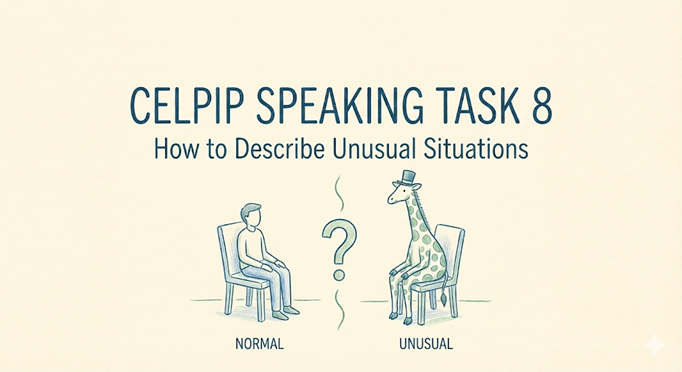
You look at the screen. You expect to see a family having dinner. Instead, you see a picture of a giraffe standing in a living room, or a woman wearing a dress made entirely of balloons.
Immediately, your brain freezes. You think, “I don’t know how to explain this!”
This is CELPIP Speaking Task 8: Describing an Unusual Situation. It is designed to test your ability to handle the unexpected.
Fortunately, you do not need to be a vocabulary genius to ace this task. You just need to learn the art of improvisation. Specifically, if you don’t know the word for something, you must describe around it.
Below is the guide to mastering the “weirdest” part of the CELPIP test without panicking
The Golden Rule: Never Stop Talking
First, understand that the raters know the image is strange. They are not checking if you know the word “giraffe.” They are checking if you can keep communicating effectively when you face a vocabulary gap.
Therefore, the worst mistake you can make is silence. Crucially, if you forget a word, never say “I don’t know” or “I forget.”
Consequently, you must use the “Definition Technique.” If you cannot name the object, describe what it looks like or what it does.
- Forgot “Telescope”? Say: “It is a long metal tube used for looking at the stars.”
- Forgot “Monocle”? Say: “He is wearing a single round glass over one eye.”
The 3-Step Structure for Task 8
Next, you need a structure to keep your answer organized. You have 60 seconds to describe the scene to someone who cannot see it (usually “your wife” or “a police officer”).
Use this simple formula:
1. The Context (10-15 Seconds)
Start by setting the scene. Where are you? Who are you calling?
- Example: “Hi honey, you won’t believe what I am looking at right now. I’m walking down Main Street and there is a really strange situation.”
2. The Detailed Description (40 Seconds)
Then, describe the specific oddities. Use prepositions to guide the listener’s eye (e.g., “In the center,” “On the left”).
- Example: “In the middle of the park, there is a large statue. Surprisingly, it looks like it is made entirely of recycled plastic bottles. It is shaped like a giant dinosaur.”
3. The Reaction (5-10 Seconds)
Finally, close with a reaction or a next step.
- Example: “It is absolutely hilarious. I’m going to take a picture and send it to you right now!”
Essential Vocabulary for “Weird” Things
Furthermore, since you will be describing strange objects, you need “vague” vocabulary that sounds professional.
Instead of saying “thing” or “stuff,” use these precise descriptors:
- Resembles: “The object resembles a classic car.”
- Appears to be: “The animal appears to be wearing a hat.”
- Peculiar: “It is a very peculiar scene.”
- Bizarre: “The situation is quite bizarre.”
Why You Need Random Practice
Admittedly, reading about CELPIP Speaking Task 8 is easy. However, doing it is hard because you cannot predict the image.
Since you might get a picture of a flooded basement or a dog driving a car, memorizing answers is impossible. Instead, you need to train your brain to react instantly to anything.
Ultimately, this is why the Smart AI Coach is your best tool.
- Random Scenarios: We generate hundreds of weird, unexpected images to test your improvisation skills.
- Vocabulary Support: If you get stuck, our AI suggests the exact word you needed (e.g., “That’s called a ‘unicycle’”).
- Confidence Building: After practicing 20 “weird” tasks, the real exam will feel easy.
[Prepare for the unexpected. Practice Task 8 with Exam Hero.]
Leave a Reply