The prompt appears on the screen. It asks you to talk about a memorable party or a time you helped a friend. Immediately, memories flood your mind. You start talking excitedly. But suddenly, the timer cuts you off before you finish your point.
This happens because most students treat CELPIP Speaking Task 2 like a casual chat. It is not. It is a structured test of your ability to recount past events accurately.
You do not need an exciting life to get a high score. You just need a solid structure. Below is the STAR Method, a simple formula to organize your story and finish perfectly on time
The Trap of the Ramble
The biggest mistake in CELPIP Speaking Task 2 is spending forty seconds setting the scene and only ten seconds on the actual event.
Raters do not care about the color of the sky that day. They care about your use of past tense verbs and chronological transitions. Therefore, if you ramble about the background details, you will run out of time for the climax of the story.
Consequently, you need a strict roadmap to keep you on track.
The STAR Method for CELPIP
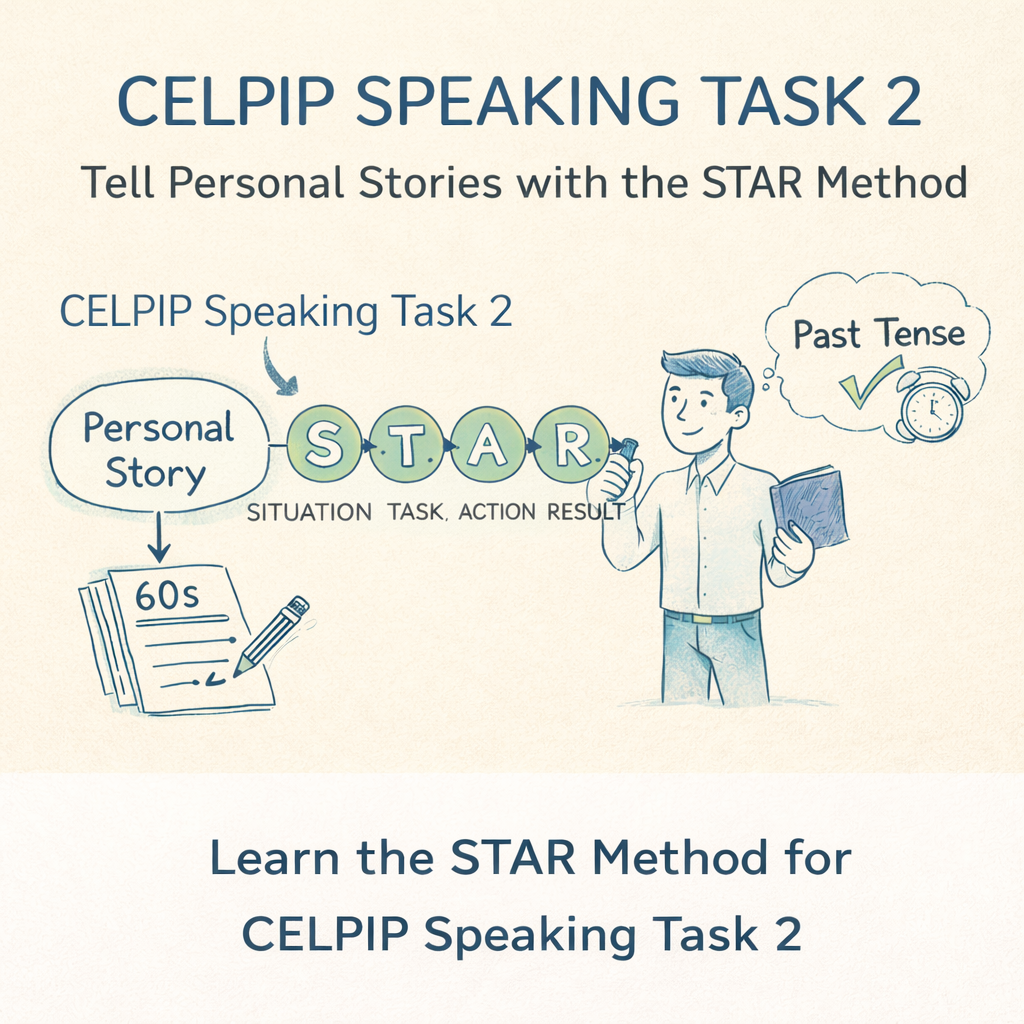
To score a CLB 9, organize your sixty seconds using the STAR framework. It divides your answer into four clean sections.
S – Situation (10 Seconds)
Start by establishing the context. Where were you? Who were you with?
- Example: Last summer, my family and I decided to go camping in Jasper National Park.
T – Task or Trigger (10 Seconds)
Next, introduce the conflict or the goal. What went wrong? What did you need to do?
- Example: When we arrived at the campsite, we realized that we had completely forgotten the tent poles.
A – Action (30 Seconds)
This is the most important part. Describe exactly what you did to solve the problem. Use strong verbs here.
- Example: We immediately searched the car for alternatives. I found some rope and a tarp in the trunk. We tied the rope between two trees and draped the tarp over it to create a makeshift shelter.
R – Result (10 Seconds)
Finally, state the outcome. How did it end? What was the lesson?
- Example: Eventually, we managed to sleep dry for the night. It taught us to always double-check our gear before leaving home.
Essential Past Tense Vocabulary
Furthermore, since this task is about the past, your grammar must reflect that. Stop using simple verbs like went or said. Instead, upgrade your language to show range.
- Transitions: Initially, Subsequently, Eventually, All of a sudden.
- Verbs: Realized, Decided, Accompanied, Discovered, Proceeded.
Using these specific words proves to the rater that you can sequence events logically.
Why You Need a Timer
Reading the STAR method is simple. Applying it in exactly sixty seconds is difficult.
If you spend too long on the Situation, you will miss the Result. This timing error instantly lowers your score. Consequently, you need a tool that forces you to stay disciplined.
This is where Exam Hero helps you win.
- Pacing Monitor: Our AI tracks your speed and tells you if you spent too much time on the introduction.
- Grammar Check: We listen for past tense errors, which are the most common mistake in this task.
- Topic Variety: Practice with hundreds of random prompts so you are ready for any story request.
Leave a Reply