The audio begins. A reporter starts speaking rapidly about a local community event or a new government policy. They use formal words like municipal, implementation, and controversy. You panic. You try to catch every single detail, but by the end, you have completely lost the main idea.
This is the harsh reality of CELPIP Listening Task 4 (News Items). It tests your ability to understand formal journalism, which sounds very different from the casual conversations in earlier parts of the test.
However, you do not need to be a political expert to score a CLB 9. You just need to understand how news is structured. Below is the Inverted Pyramid strategy, the secret to predicting where the answers are hiding before you even hear the questions.
The Challenge: Why News English is So Hard
First, we must accept why this task feels impossible. It is not just faster; it is denser.
Specifically, news reports use two things that confuse second-language speakers:
- Formal Vocabulary: Instead of saying car, they say vehicle. Instead of people living there, they say residents.
- The Passive Voice: instead of saying The mayor signed the law, reports often say The law was signed by the mayor. This flips the sentence structure and makes it harder to track who did what.
Consequently, if you try to translate every word in your head, you will fall behind instantly.
The Solution: The Inverted Pyramid Structure
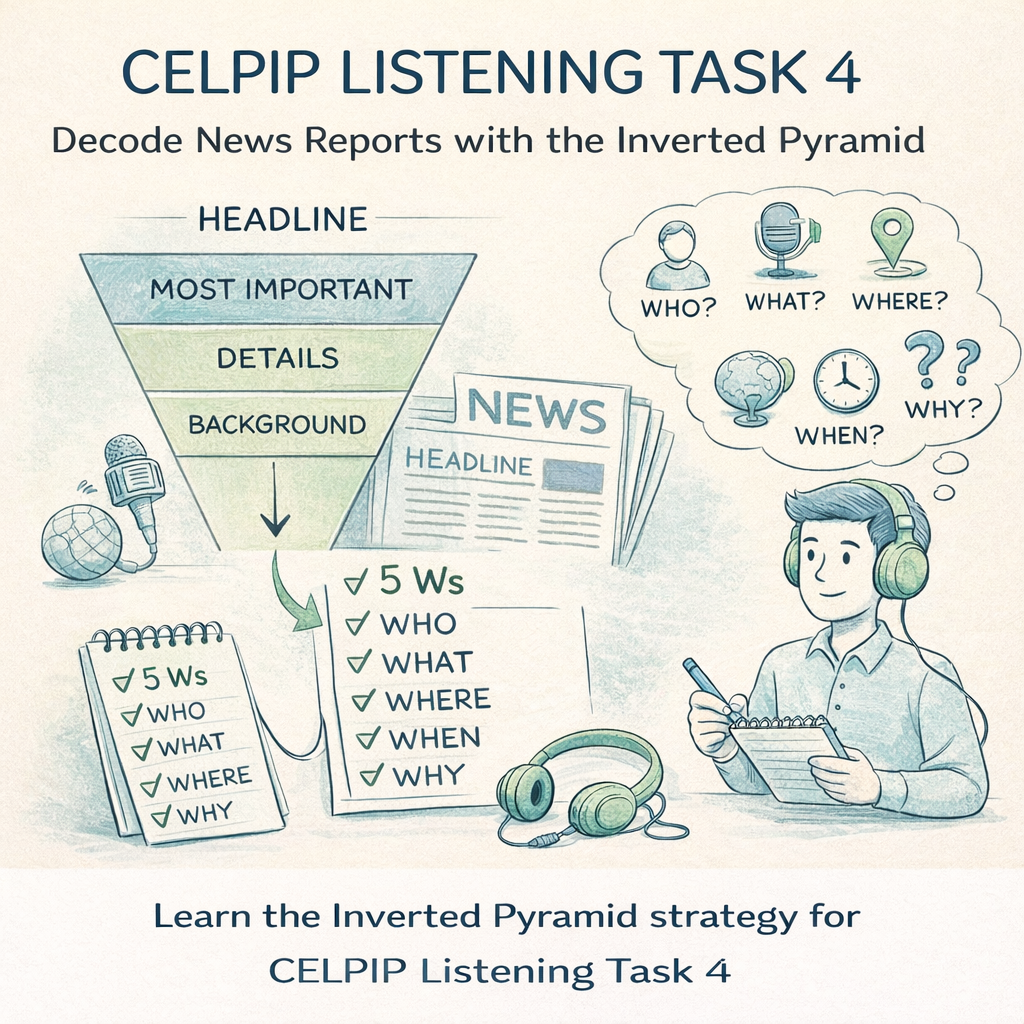
Next, you need to learn the secret of journalism. Reporters do not save the best for last. They put the most important information at the very beginning. This is called the Inverted Pyramid style.
Imagine an upside-down triangle. The widest part at the top contains the crucial facts. The narrow tip at the bottom contains minor details.
Therefore, your strategy must change. Do not give equal attention to the whole three minutes. The first forty-five seconds are the most critical part of the audio track. If you zone out at the start, you miss the core story.
The 5 Ws Checklist (What to Listen For)
Furthermore, you need a specific checklist for those vital first forty-five seconds. Do not just listen passively. Actively hunt for the 5 Ws.
As soon as the audio starts, mentally tick these off:
- Who is involved? (e.g., The local school board).
- What happened? (e.g., They voted to change the bus schedule).
- Where did it take place? (e.g., In the downtown district).
- When will it happen? (e.g., Starting next September).
- Why does it matter? (e.g., To save money on fuel).
Usually, three or four of the test questions will be based entirely on these first few sentences.
Essential News Vocabulary Triggers
Finally, you can boost your score by recognizing common news triggers. When you hear these formal words, pay close attention, as an important fact usually follows.
- According to: Signals the source of information.
- Proposed: A plan that is not yet final.
- Residents: The people affected by a local issue.
- Officials: People in authority (police, government).
- Incident: A formal word for an event or accident.
Why You Need Realistic News Drills
Admittedly, understanding the Inverted Pyramid concept is easy. Applying it when a reporter is speaking full speed about a complex topic is difficult.
Unfortunately, watching regular TV news often does not help because it is too visual and too fast. You need audio-only practice tailored to the CELPIP level.
This is where Exam Hero gives you the advantage.
- News Simulations: Practice with hundreds of audio tracks that mimic the exact speed, tone, and vocabulary of the real test.
- The 30-Second Drill: Our app trains you to extract the 5 Ws in the first thirty seconds of a clip, building your focused listening stamina.
- Vocabulary Highlighter: We identify the formal news terms you missed so you can add them to your study list.
[Stop fearing the news report. Master Listening Task 4 with the Smart AI Coach.]
Leave a Reply