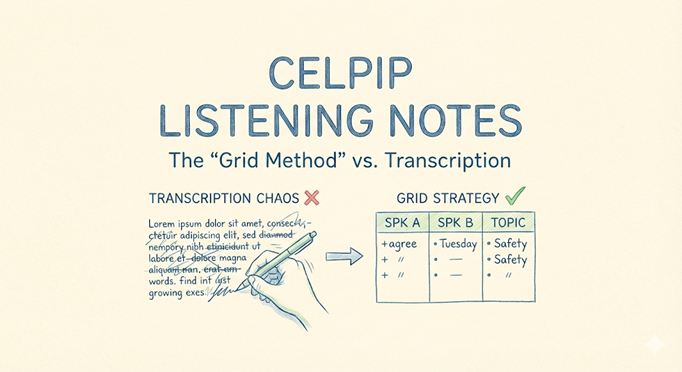
The audio starts. You grab your pen. Immediately, you start furiously scribbling every word you hear. By the time the audio finishes, your hand hurts, your page is full of messy sentences, and you have no idea what the main point of the conversation was.
Does this sound familiar?
Unfortunately, this “transcription approach” is the fastest way to fail the CELPIP Listening section. You cannot write as fast as a native speaker talks. Consequently, when you try to capture everything, you miss the crucial context clues needed to answer the questions.
To hit CLB 9+, you need to stop transcribing and start strategizing. Below is the “Grid Method,” a simple note-taking system that forces you to focus only on what matters.
The “Transcription Trap” Why Less Is More
Admittedly, it feels safer to write everything down. You worry that if you don’t write it, you will forget it.
However, the human brain struggles to perform two complex tasks, active listening and writing full sentences—simultaneously. As a result, when you focus on writing, your brain stops processing the meaning behind the words.
Therefore, the goal of CELPIP Listening notes is not to create a transcript. It is to create a “cheat sheet” of keywords that triggers your short-term memory when the questions appear.
How to Use the “Grid Method”
Next, let’s replace your messy notes with a structured grid. Do this before the audio starts.
Specifically, draw a simple “T-chart” or grid on your scratch paper. Label the columns based on the task type.
For Conversations (Parts 1-3):
- Column 1: Speaker A (e.g., Man)
- Column 2: Speaker B (e.g., Woman)
- Column 3: Topic/Problem
As you listen, only write keywords under the correct person’s column. Use symbols like (+) for agreement or (-) for disagreement. This makes it instantly clear who holds which opinion.
What to Write (And What to Ignore)
Knowing what to put in the grid is crucial.
Crucially, focus on “Unchangeable Keywords”:
- Names: (Write “Sarah,” not “her friend”)
- Dates/Times: (Write “Tuesday @ 3pm”)
- Locations: (Write “Library”)
- Strong Opinions: (Write “Hates new policy (-)”)
In contrast, ignore the fluff:
- Ignore full sentences. (Never write “The man said he was going to…”)
- Ignore filler words. (Um, ah, like, you know…)
- Ignore minor details. (If the main topic is a lost job, don’t write down what they had for lunch).
The “Video Task” Myth (Task 5)
Furthermore, this strategy is vital for the dreaded Video Task.
Many students panic and try to write down visual details, like the color of the curtains or what is on a coffee table. Surprisingly, the CELPIP test rarely asks about these background details. The questions focus on the conversation and the speakers’ attitudes.
Consequently, keep your eyes on the screen to gauge emotions, but keep your pen focused on the dialogue keywords in your grid.
Why You Cannot Practice This with a Book
Reading about the “Grid Method” for CELPIP Listening is easy. Applying it under time pressure when people are speaking fast Canadian English is hard.
You cannot train your ears with a static textbook. You need realistic, dynamic practice.
Ultimately, this is why the Smart AI Coach is essential.
- Realistic Audio: Practice with hundreds of conversations that mimic real CELPIP speeds and accents.
- Active Comprehension: Our questions are designed to test if you caught the keywords, not the fluff.
- Instant Feedback: See immediately which details you missed so you can refine your note-taking strategy for the next round.
[Stop transcribing. Start listening strategically with Exam Hero.]
Leave a Reply