Category: Uncategorized

  • CELPIP Listening Task 2: The Invisible Question Trap

    CELPIP Listening Task 2: The Invisible Question Trap

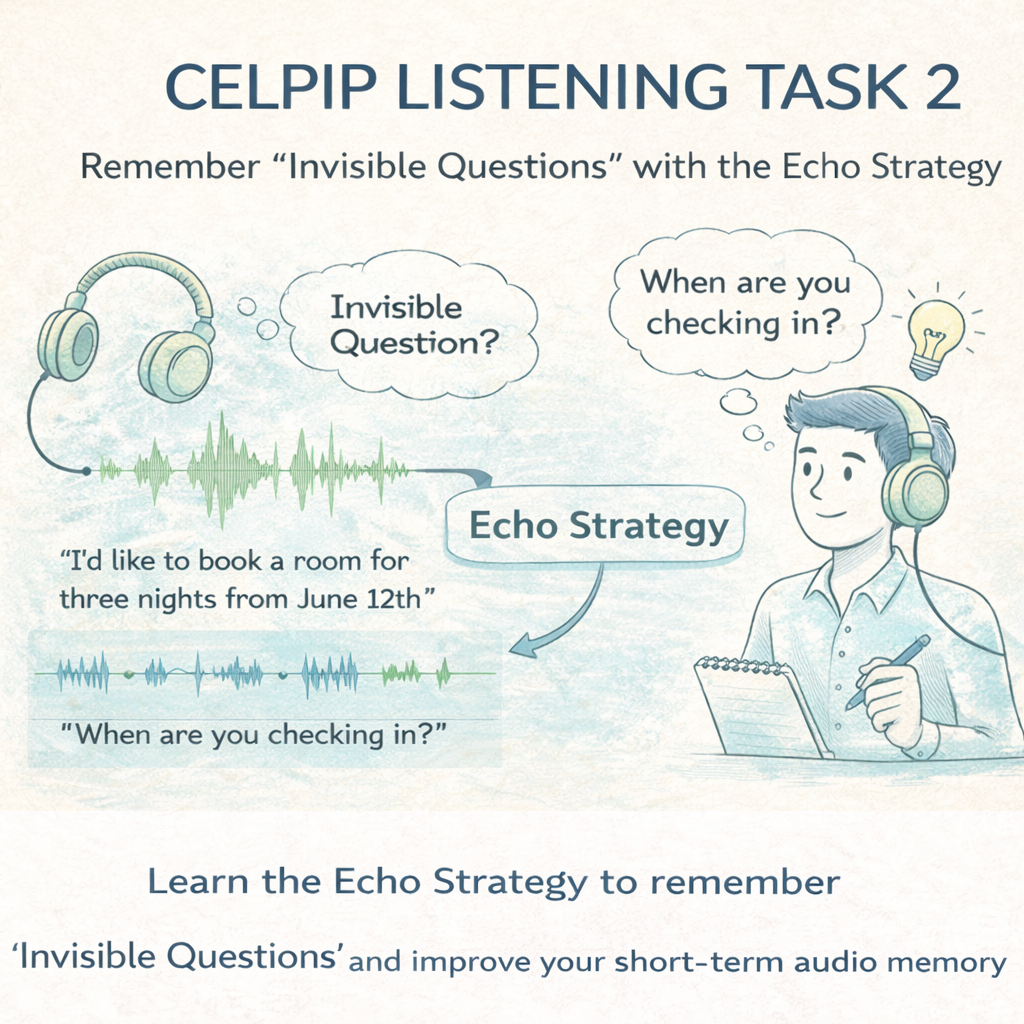
    The audio track begins with a conversation about a broken heater or a hiking trip. As you listen, you jot down a few notes and feel confident. Then, the audio stops, and a voice asks a question.

    Then, the audio stops. A voice asks a question.

    Suddenly, you panic. The question is not on the screen. You have to rely entirely on your memory of what the voice just asked. If you didn’t hear it perfectly, or if you forgot it while looking at the answers, you are guessing blindly.

    This is the unique challenge of CELPIP Listening Task 2 (Answering Questions). It is the only part of the test where the question itself is invisible.

    To hit CLB 9, you need to stop relying on your eyes and start trusting your “Audio Memory.” Below is the Echo Strategy to ensure you never forget the question.

    The Challenge: The Memory Gap

    First, understand why this is hard. In other tasks, you can re-read the question while you think. In Task 2, the question exists only for three seconds in the air.

    Consequently, many students hear the question, look down at the four options (A, B, C, D), and in that split second of reading the options, they forget the specific detail asked in the question.

    • Did they ask WHERE they are going or WHEN they are going?

    If you mix up “Where” and “When,” you will pick the wrong answer because the test often includes distractors for both.

    The Solution: The “Echo Strategy”

    Next, use the Echo Strategy to bridge the gap between hearing and answering.

    The Rule: Do not look at the answers immediately.

    When the voice asks the question, repeat it silently in your head (Echo it) before you look at the options.

    1. Audio: “Why did the man refuse the offer?”
    2. Your Brain (The Echo): “Why refuse? Why refuse? Why refuse?”
    3. Action: Now look at the options.

    This 2-second loop locks the question into your short-term memory so the text on the screen doesn’t distract you.

    Note-Taking: The “Q&A” Method

    Furthermore, your notes need to change for this section. Since you don’t know the questions, you must capture the Main Points of the dialogue.

    Use the Q&A shorthand:

    • If the woman asks: “Are you free at 5 PM?”
    • And the man says: “No, I have a dentist appointment.”
    • Write: Man -> Busy 5pm (Dentist).

    You are not just writing words; you are writing the reasoning. The test almost always asks about the reasons (Why), not just the facts (What).

    The “tone” Clue

    Finally, sometimes the answer is hidden in the speaker’s emotion, not their words.

    • Question: What is the woman’s attitude?
    • Option A: She is excited about the trip.
    • Option B: She is hesitant.

    Even if you didn’t understand every word, think back to her voice. Was it high and fast (Excited)? or slow and low (Hesitant)? In Task 2, the intonation is often the biggest clue.

    Why You Need Blind Practice

    Admittedly, practicing this is hard because most books show you the question. This destroys the purpose of the exercise. You need to practice Blind Listening.

    Unfortunately, reading a transcript won’t help your short-term memory.

    This is where Exam Hero helps you win.

    • Invisible Question Mode: Our app simulates the real test conditions, playing the question via audio only and hiding the text.
    • Memory Timer: We train you to hold the question in your head for 5 seconds before answering.
    • Echo Drills: We practice “Question Repetition” to strengthen your audio memory loop.

    [Stop guessing what you heard. Master the Invisible Question with the Smart AI Coach.]

  • CELPIP Reading Task 2: Why You Should Ignore the Flyer

    CELPIP Reading Task 2: Why You Should Ignore the Flyer

    A colorful image appears on the screen. It is a brochure for a travel package, or perhaps a flyer for a furniture sale. It is packed with bold headers, tiny footnotes, discount codes, and confusing prices.

    Your instinct is to start reading from the top. First, you carefully study the prices. Next, you try to memorize the dates, and finally, you read every single word of the fine print.

    Three minutes later, you look at the questions and realize you have forgotten everything.

    This is the classic trap of CELPIP Reading Task 2 (Applying a Diagram). The test designers intentionally overload the image with useless information to waste your time.

    To hit CLB 9, you need to stop reading and start hunting. Below is the Email First strategy, a method that allows you to ignore 80% of the diagram and find the answers in seconds.

    The Trap: The Information Overload

    First, you must understand the design of this task. The diagram usually contains four different options (e.g., four different hotels). However, the questions will usually only ask about one or two of them.

    Consequently, if you spend five minutes reading about Hotel A, but the questions are all about Hotel B, you have just wasted valuable exam time.

    Therefore, reading the diagram first is a strategic error. It is like reading the entire phone book just to find one number.

    The Solution: The Email First Strategy

    Next, flip your process. On the right side of the screen, there is an email from a friend or colleague asking for advice. This email contains your Shopping List.

    Do not look at the flyer. Read the email first.

    As you read, identify the specific constraints the person has.

    • Budget: I can only spend $500.
    • Date: I am only free on weekends.
    • Location: I need to be near the airport.

    Now you have a mission. You are no longer reading a random flyer; you are hunting for a weekend trip under $500 near the airport.

    The Scanning Technique (Hunt, Don’t Read)

    Furthermore, once you have your Shopping List, go back to the diagram. Do not read the sentences. Scan for the specific data types.

    • If the email mentions Money, your eyes should only look for $ symbols.
    • If the email mentions Dates, your eyes should only look for Months and Numbers.
    • If the email mentions Safety, your eyes should only look for Asterisks (*) and fine print.

    This selective attention allows you to answer questions in seconds because you are ignoring everything that does not match your list.

    The “Not Mentioned” Trap

    Admittedly, there is one tricky part. Sometimes the email asks for a detail that is not in the main description but is hidden in the footnotes.

    For example, the email might ask: Is breakfast included?

    You scan the main hotel description and see nothing about food. Do not assume the answer is No. Look at the bottom of the flyer. There is often a tiny code or footnote that says Includes continental breakfast.

    The test loves to hide the most important answers in the smallest text. Always check the footer.

    Why You Need Scavenger Hunt Drills

    Ultimately, this task is not about reading comprehension; it is about data extraction. You need to train your eyes to ignore distractions.

    Unfortunately, reading normal articles does not help with this. You need messy, cluttered diagrams to practice effectively.

    This is where Exam Hero helps you win.

    • Visual Clutter Training: We provide realistic, messy flyers that force you to practice ignoring useless information.
    • Constraint Drills: We give you a specific goal (e.g., Find the cheapest option with a pool) and time how fast you can find it.
    • Fine Print Hunter: Our AI specifically quizzes you on the footnotes, training you to always check the bottom of the page.

    [Stop wasting time reading the whole flyer. Master the Email First strategy with the Smart AI Coach.]

  • CELPIP Reading Task 1: Finding the Invisible Answers

    CELPIP Reading Task 1: Finding the Invisible Answers

    You read the email. It seems simple. A person is writing to someone named John about a meeting. You understand every word.

    Then you look at the first question: What is the relationship between the sender and the recipient?

    You panic. You scan the text again. Nowhere does it say we are colleagues or we are friends. You start guessing.

    This is the hidden trap of CELPIP Reading Task 1. The test does not just measure your ability to read words; it measures your ability to read between the lines. These are called Inference Questions, and they are the main reason students get stuck at CLB 8.

    To score a CLB 9, you need to stop looking for facts and start looking for clues. Below is the Tone Radar strategy to help you find answers that are not explicitly written.

    The Challenge: The Information Gap

    First, you must understand that Canadian culture is high-context. We often do not state the obvious.

    For example, if I am writing to my boss, I do not start the email by saying: Since you are my boss, I am writing to you. That would be weird. Instead, I show that relationship through my Tone.

    Consequently, the test expects you to act like a detective. You must use the formality of the language to deduce the relationship.

    The Solution: The Tone Radar

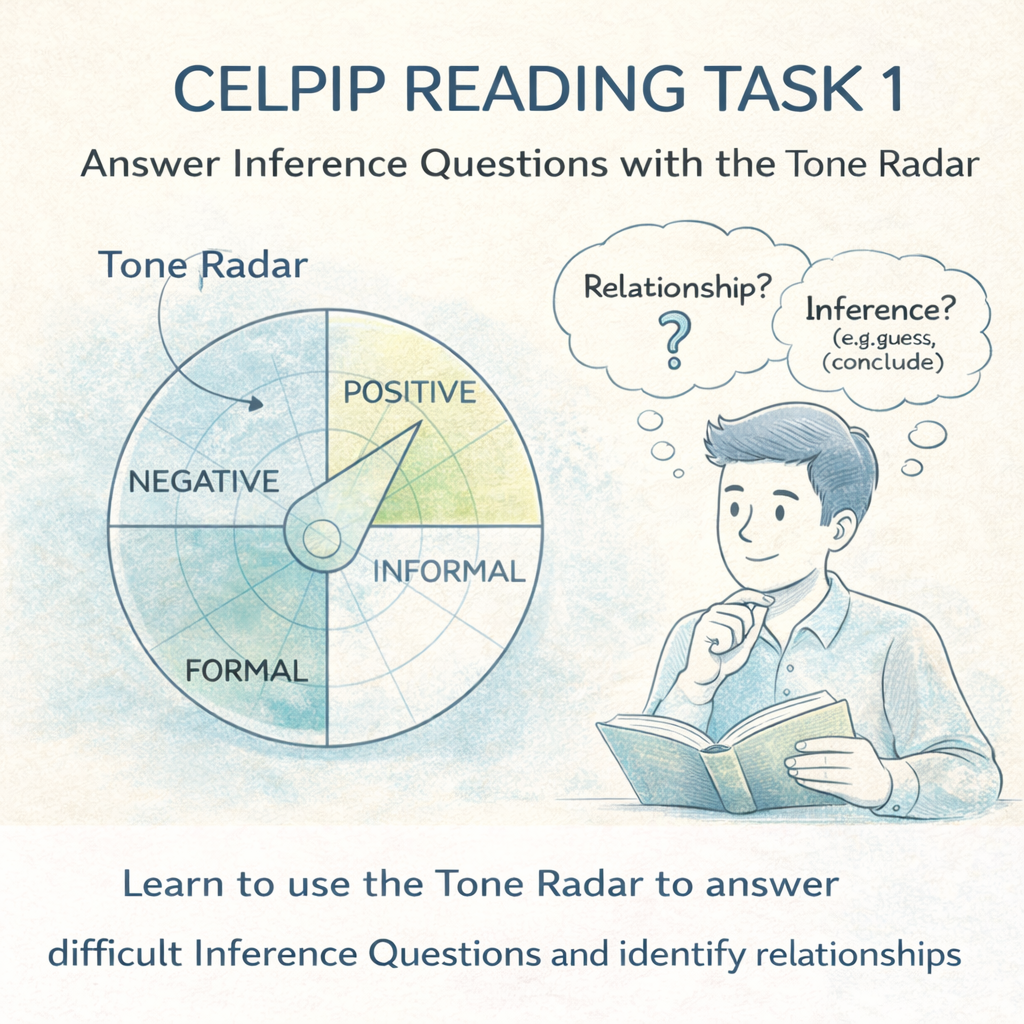
    Next, use the Tone Radar technique. Before you answer any questions, look at the Opener and the Closer. These two small areas contain 90% of the relationship clues.

    1. The Salutation (The Opener)

    • Hi John / Hey John: This indicates a Close relationship (Friend, Family, or Close Colleague).
    • Dear Mr. Smith: This indicates a Formal relationship (Client, Stranger, or Boss).
    • Dear John: This is the Neutral Zone (could be a Colleague or an Acquaintance).

    2. The Sign-Off (The Closer)

    • Love / Cheers / Best: This confirms a Personal connection.
    • Sincerely / Regards: This confirms a Professional or Distant connection.
    • Thanks: This is neutral but usually implies a Request was made.

    Therefore, if the email starts with Hey John and ends with Cheers, the answer to What is the relationship? is almost certainly Friends or Close Colleagues, even if the text never says the word friend.

    How to Spot Hidden Emotions

    Furthermore, you will often face questions about how the writer feels.

    • Question: How does the writer feel about the delay?
    • Text: I was a bit surprised to hear about the schedule change.

    In Canadian English, we rarely say I am angry. We use softeners.

    • A bit surprised usually means Annoyed.
    • It is unfortunate usually means I am disappointed.
    • I would appreciate usually means I expect you to do this.

    If you take the literal meaning, you will choose Suprised (Neutral). If you use your Tone Radar, you will correctly choose Annoyed (Negative).

    The Reference Trap (This and That)

    Finally, pay close attention to pronouns like This, That, and It.

    In CELPIP Reading Task 1, a common question will ask: What does the writer mean by ‘this situation’?

    To find the answer, you must look at the sentence immediately before the pronoun.

    • Text: The printer has been broken for a week, and the repair technician cancelled twice. This situation is unacceptable.
    • Question: What is the situation?
    • Answer: The combination of the broken printer AND the cancelled technician. (Many students make the mistake of only choosing the broken printer).

    Why You Need Inference Drills

    Admittedly, reading between the lines is the hardest skill to learn because it is cultural. You cannot memorize it from a dictionary; you must experience it.

    Unfortunately, most free practice tests only ask literal questions. They do not train you for the subtle inference questions on the real exam.

    This is where Exam Hero gives you the edge.

    • Inference Training: We specifically highlight the Tone Clues in every practice email so you learn to spot them.
    • Cultural Decoder: Our AI explains why a bit surprised actually means angry in a Canadian workplace context.
    • Pronoun Hunt: We force you to link every This and That to its correct reference, ensuring you never miss a reference question.

    [Stop guessing the relationship. Master Inference with the Smart AI Coach.]

  • CELPIP Writing Task 1: The Apology Email Template

    CELPIP Writing Task 1: The Apology Email Template

    You open the writing prompt. It says: You borrowed a book from your local library and lost it. Write an email to the librarian to apologize, explain what happened, and offer a solution.

    Immediately, you feel nervous. You know how to complain, but do you know how to say sorry correctly in Canada?

    This is the challenge of CELPIP Writing Task 1 (The Apology). Unlike a complaint, where you need to be firm, an apology requires you to be humble, sincere, and responsible. If you sound too casual, you will seem rude. If you sound too dramatic, you will seem unprofessional.

    To hit CLB 9, you need the perfect balance. Below is the 3-R Formula, a simple template to ensure your apology is accepted every time.

    The Challenge: Tone is Everything

    First, understand that the raters are judging your Tone more than your truthfulness. They do not care if you actually lost a book. They care if you sound like a polite, responsible adult.

    Consequently, you must avoid the Defensive Trap. This is when you apologize but immediately blame someone else.

    • Bad Tone (Defensive): I am sorry I missed the meeting, but the traffic was terrible and my alarm broke.
    • Good Tone (Responsible): Please accept my sincere apologies for missing the meeting. I failed to account for the heavy traffic this morning.

    See the difference? The first one makes excuses. The second one takes responsibility.

    The Solution: The 3-R Formula

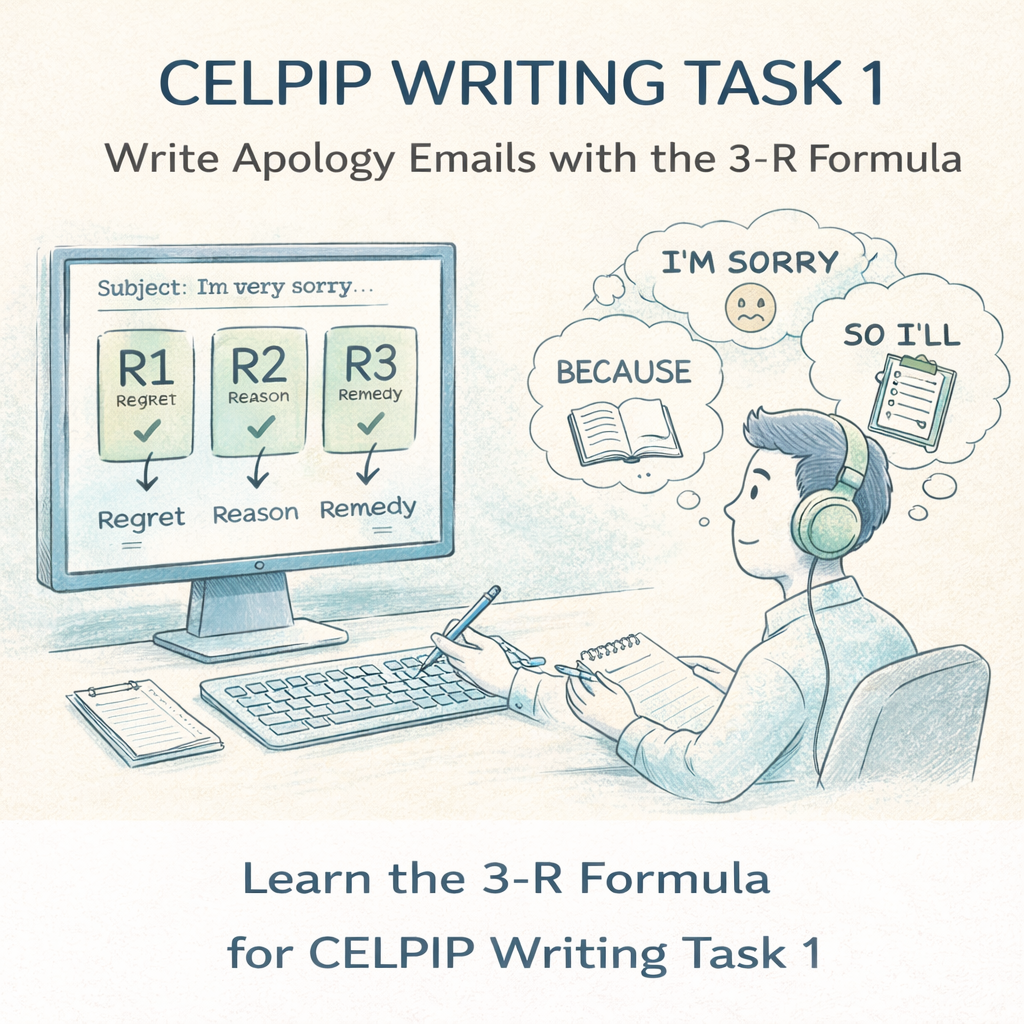
    Next, structure your email using the 3-R Formula. This ensures you cover all the bullet points in the prompt without getting off track.

    1. Regret ( The Immediate Apology)

    Start your email by apologizing immediately in the first sentence. Do not bury the lead.

    • Formal Phrase: Please accept my sincerest apologies for…
    • Informal Phrase: I am so incredibly sorry about…

    2. Reason (The Honest Explanation)

    Then, briefly explain what happened. Keep it simple and believable. Do not write a long, complicated story.

    • Example: While I was moving apartments last weekend, the box containing the library book was unfortunately misplaced by the movers.

    3. Remedy (The Solution)

    Finally, offer a way to fix the problem. This is the most important part because it shows you are solution-oriented.

    • Example: I would like to pay for the full replacement cost of the book. Please let me know the amount so I can transfer the funds immediately.

    Formal vs. Informal Apologies

    Furthermore, you must adjust your vocabulary based on who you are emailing.

    If writing to a Boss or Librarian (Formal):

    • Use: I apologize / I regret to inform you / Please forgive the oversight.
    • Avoid: I messed up / Sorry about that / My bad.

    If writing to a Friend or Neighbor (Informal):

    • Use: I feel terrible / I am so sorry / I can’t believe I did this.
    • Avoid: Please accept my formal apology / I regret the incident.

    Why You Need Tone Feedback

    Admittedly, judging your own tone is nearly impossible. You might think you sound polite, but a native speaker might think you sound sarcastic or cold.

    Unfortunately, Microsoft Word will check your spelling, but it will not check your politeness level.

    This is where Exam Hero excels.

    • Tone Detector: Our AI analyzes your writing and tells you if you sound angry, defensive, or sincere.
    • Template Training: We force you to practice the 3-R Formula until it becomes automatic.
    • Formal vs. Informal Drills: We give you the same scenario (e.g., being late) and ask you to write it twice: once for a boss, and once for a friend.

    [Stop guessing your tone. Write perfect emails with the Smart AI Coach.]

  • CELPIP Listening Task 4: Decoding News Items with the Inverted Pyramid

    CELPIP Listening Task 4: Decoding News Items with the Inverted Pyramid

    The audio begins. A reporter starts speaking rapidly about a local community event or a new government policy. They use formal words like municipal, implementation, and controversy. You panic. You try to catch every single detail, but by the end, you have completely lost the main idea.

    This is the harsh reality of CELPIP Listening Task 4 (News Items). It tests your ability to understand formal journalism, which sounds very different from the casual conversations in earlier parts of the test.

    However, you do not need to be a political expert to score a CLB 9. You just need to understand how news is structured. Below is the Inverted Pyramid strategy, the secret to predicting where the answers are hiding before you even hear the questions.

    The Challenge: Why News English is So Hard

    First, we must accept why this task feels impossible. It is not just faster; it is denser.

    Specifically, news reports use two things that confuse second-language speakers:

    1. Formal Vocabulary: Instead of saying car, they say vehicle. Instead of people living there, they say residents.
    2. The Passive Voice: instead of saying The mayor signed the law, reports often say The law was signed by the mayor. This flips the sentence structure and makes it harder to track who did what.

    Consequently, if you try to translate every word in your head, you will fall behind instantly.

    The Solution: The Inverted Pyramid Structure

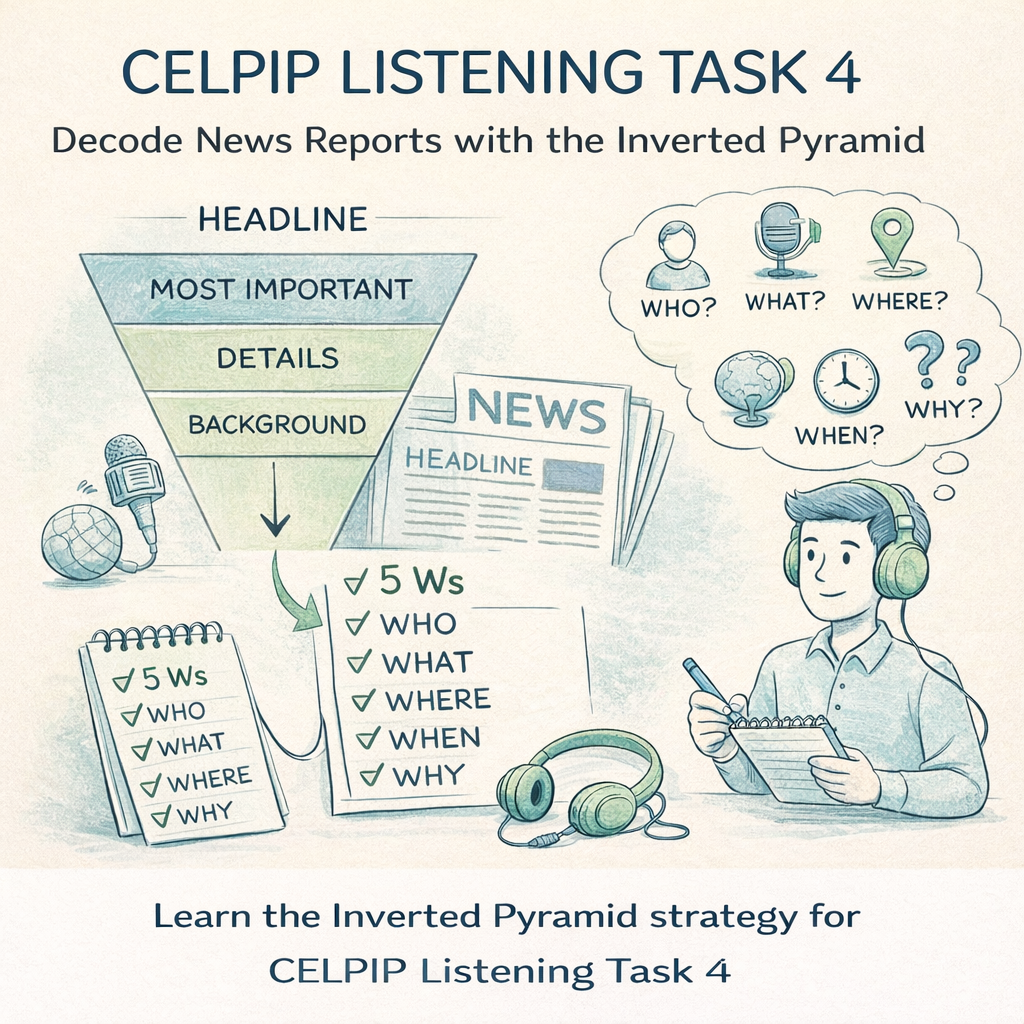
    Next, you need to learn the secret of journalism. Reporters do not save the best for last. They put the most important information at the very beginning. This is called the Inverted Pyramid style.

    Imagine an upside-down triangle. The widest part at the top contains the crucial facts. The narrow tip at the bottom contains minor details.

    Therefore, your strategy must change. Do not give equal attention to the whole three minutes. The first forty-five seconds are the most critical part of the audio track. If you zone out at the start, you miss the core story.

    The 5 Ws Checklist (What to Listen For)

    Furthermore, you need a specific checklist for those vital first forty-five seconds. Do not just listen passively. Actively hunt for the 5 Ws.

    As soon as the audio starts, mentally tick these off:

    • Who is involved? (e.g., The local school board).
    • What happened? (e.g., They voted to change the bus schedule).
    • Where did it take place? (e.g., In the downtown district).
    • When will it happen? (e.g., Starting next September).
    • Why does it matter? (e.g., To save money on fuel).

    Usually, three or four of the test questions will be based entirely on these first few sentences.

    Essential News Vocabulary Triggers

    Finally, you can boost your score by recognizing common news triggers. When you hear these formal words, pay close attention, as an important fact usually follows.

    • According to: Signals the source of information.
    • Proposed: A plan that is not yet final.
    • Residents: The people affected by a local issue.
    • Officials: People in authority (police, government).
    • Incident: A formal word for an event or accident.

    Why You Need Realistic News Drills

    Admittedly, understanding the Inverted Pyramid concept is easy. Applying it when a reporter is speaking full speed about a complex topic is difficult.

    Unfortunately, watching regular TV news often does not help because it is too visual and too fast. You need audio-only practice tailored to the CELPIP level.

    This is where Exam Hero gives you the advantage.

    • News Simulations: Practice with hundreds of audio tracks that mimic the exact speed, tone, and vocabulary of the real test.
    • The 30-Second Drill: Our app trains you to extract the 5 Ws in the first thirty seconds of a clip, building your focused listening stamina.
    • Vocabulary Highlighter: We identify the formal news terms you missed so you can add them to your study list.

    [Stop fearing the news report. Master Listening Task 4 with the Smart AI Coach.]

  • CELPIP Speaking Task 2: How to Tell a Personal Story

    CELPIP Speaking Task 2: How to Tell a Personal Story

    The prompt appears on the screen. It asks you to talk about a memorable party or a time you helped a friend. Immediately, memories flood your mind. You start talking excitedly. But suddenly, the timer cuts you off before you finish your point.

    This happens because most students treat CELPIP Speaking Task 2 like a casual chat. It is not. It is a structured test of your ability to recount past events accurately.

    You do not need an exciting life to get a high score. You just need a solid structure. Below is the STAR Method, a simple formula to organize your story and finish perfectly on time

    The Trap of the Ramble

    The biggest mistake in CELPIP Speaking Task 2 is spending forty seconds setting the scene and only ten seconds on the actual event.

    Raters do not care about the color of the sky that day. They care about your use of past tense verbs and chronological transitions. Therefore, if you ramble about the background details, you will run out of time for the climax of the story.

    Consequently, you need a strict roadmap to keep you on track.

    The STAR Method for CELPIP

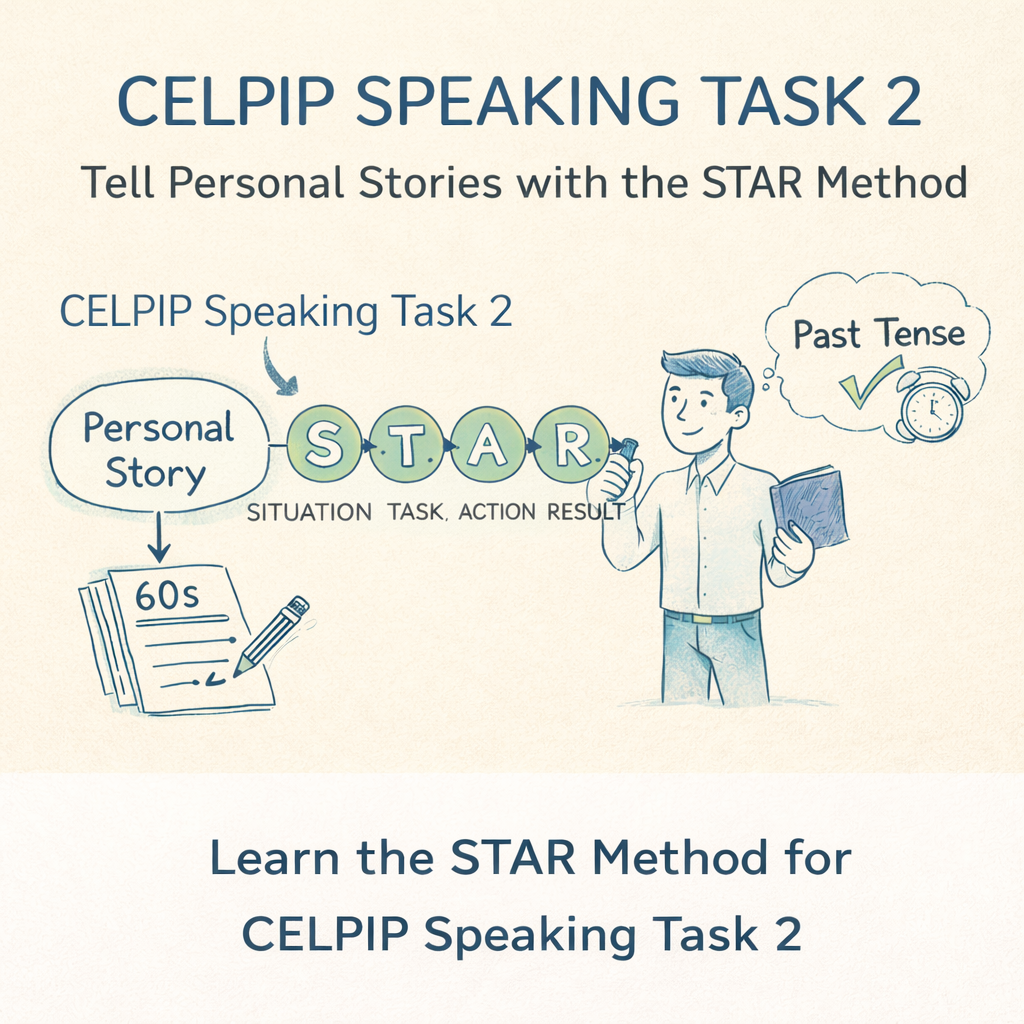
    To score a CLB 9, organize your sixty seconds using the STAR framework. It divides your answer into four clean sections.

    S – Situation (10 Seconds)

    Start by establishing the context. Where were you? Who were you with?

    • Example: Last summer, my family and I decided to go camping in Jasper National Park.

    T – Task or Trigger (10 Seconds)

    Next, introduce the conflict or the goal. What went wrong? What did you need to do?

    • Example: When we arrived at the campsite, we realized that we had completely forgotten the tent poles.

    A – Action (30 Seconds)

    This is the most important part. Describe exactly what you did to solve the problem. Use strong verbs here.

    • Example: We immediately searched the car for alternatives. I found some rope and a tarp in the trunk. We tied the rope between two trees and draped the tarp over it to create a makeshift shelter.

    R – Result (10 Seconds)

    Finally, state the outcome. How did it end? What was the lesson?

    • Example: Eventually, we managed to sleep dry for the night. It taught us to always double-check our gear before leaving home.

    Essential Past Tense Vocabulary

    Furthermore, since this task is about the past, your grammar must reflect that. Stop using simple verbs like went or said. Instead, upgrade your language to show range.

    • Transitions: Initially, Subsequently, Eventually, All of a sudden.
    • Verbs: Realized, Decided, Accompanied, Discovered, Proceeded.

    Using these specific words proves to the rater that you can sequence events logically.

    Why You Need a Timer

    Reading the STAR method is simple. Applying it in exactly sixty seconds is difficult.

    If you spend too long on the Situation, you will miss the Result. This timing error instantly lowers your score. Consequently, you need a tool that forces you to stay disciplined.

    This is where Exam Hero helps you win.

    • Pacing Monitor: Our AI tracks your speed and tells you if you spent too much time on the introduction.
    • Grammar Check: We listen for past tense errors, which are the most common mistake in this task.
    • Topic Variety: Practice with hundreds of random prompts so you are ready for any story request.

    [Master your storytelling skills with the Smart AI Coach.]

  • CELPIP Reading Task 3: The Synonym Swap Strategy

    CELPIP Reading Task 3: The Synonym Swap Strategy

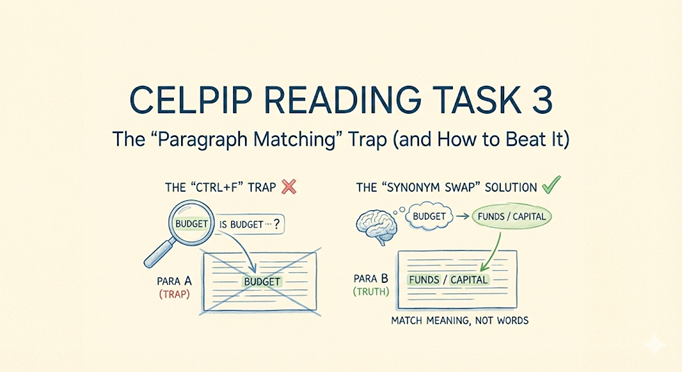
    You are staring at the four paragraphs in CELPIP Reading Task 3, labeled A, B, C, and D. Below them is a list of nine statements, and your job is to decide which paragraph contains the information. Scanning the text, you see the word ‘budget’ in Paragraph A. Immediately, you click ‘A’ and move on, feeling confident

    Unfortunately, you likely just fell into the most common trap in CELPIP Reading Task 3.

    The test designers know you are rushing. They know you are using “Ctrl+F” with your eyes. So, they set a trap: they put the exact keyword in the wrong paragraph, while hiding the correct answer behind a synonym in a different paragraph.

    To hit CLB 9, you need to stop looking for matching words and start looking for matching meanings. Below is the guide to mastering the “Synonym Swap” Strategy.

    The “Ctrl+F” Mistake (Why You Are Losing Points)

    First, we need to break your bad habit. In easier English tests, scanning for the exact word works. In CELPIP, it is often a decoy.

    Specifically, there are two types of traps in Task 3:

    1. The “Exact Word” Decoy: The question says “financial aid.” Paragraph A says “financial aid” (but talks about something else). Paragraph C says “monetary assistance” (this is the real answer).
    2. The “Partial Match” Trap: The paragraph mentions the topic, but doesn’t confirm the specific detail asked for in the statement.

    Therefore, if you see the exact same word in the question and the text, be suspicious. It is usually a trap.

    The Solution: The “Synonym Swap” Strategy

    Next, change your mindset. The test is not a word-search puzzle; it is a vocabulary test disguised as a reading test.

    Consequently, before you scan the text, you must predict synonyms for the key words in the question.

    The “Trap vs. Truth” Table

    Here is what this looks like in practice. Let’s say the question is: “The company is facing financial ruin.”

    ParagraphWhat the Text SaysIs it the Answer?
    Paragraph A“The company has strong financial backing from investors.”NO (Trap). It uses the word “financial,” but the meaning is opposite (strong vs. ruin).
    Paragraph B“The firm is currently on the brink of bankruptcy.”YES (Truth). It doesn’t use the word “financial,” but “bankruptcy” is a perfect synonym for “financial ruin.”

    Crucially, the correct answer often contains zero words from the question.

    Step-by-Step Execution Plan

    Now, follow this workflow to clear the section in under 10 minutes without panicking.

    Step 1: Read the Statements First (Not the Text)

    Do not waste time reading the whole article. Go straight to the questions.

    • Action: Read Statement 1. Underline the “content words” (nouns and verbs).

    Step 2: Generate “Ghost Words”

    Immediately think of 1 or 2 synonyms for those underlined words.

    • Question: “The park is closing for repairs.”
    • Ghost Words: “Shutting down,” “renovations,” “maintenance,” “fixing.”

    Step 3: Scan for the “Ghost Words”

    Now scan the four paragraphs looking for your ghost words, not the original words.

    • Result: You find “scheduled maintenance” in Paragraph D. That’s your match.

    Dealing with “E” (Not Given)

    Admittedly, sometimes the answer is “E” (The statement is not mentioned in any paragraph). This is the hardest option to choose because it requires confidence.

    However, use the “2-Pass Rule.”

    1. Pass 1: Scan for your synonyms. If you find a match, mark it.
    2. Pass 2: If you found nothing, do a quick check for the topic concept. If the specific detail is truly missing, mark “E” and move on.
    3. Warning: Do not spend 3 minutes hunting for something that isn’t there. If you can’t find it in 60 seconds, it’s likely “E.”

    Why You Can’t Practice This with Generic News

    Ultimately, reading the BBC or CNN won’t help you here. News articles aren’t designed to trick you; they are designed to inform you.

    You need practice materials that are intentionally engineered with “Distractor Traps.”

    This is where Exam Hero is essential.

    • Synonym Drills: Our AI highlights the key words in the question and shows you the matching synonyms in the text, training your brain to make the connection.
    • Trap Detection: We explain why you got an answer wrong (e.g., “You fell for the ‘Exact Word’ trap in Paragraph A”).
    • Speed Training: Practice scanning 4 paragraphs in under 2 minutes to build your reading stamina.

    [Stop falling for the traps. Master the Synonym Swap with Exam Hero.]

  • CELPIP Speaking Tasks 3 & 4: Mastering the Describe & Predict Combo

    CELPIP Speaking Tasks 3 & 4: Mastering the Describe & Predict Combo

    A complex image appears on the screen. It’s a busy park with twenty different people doing twenty different things. A timer counts down. You have 60 seconds to describe it to someone who can’t see it.

    Suddenly, your mind goes blank. You start listing random objects: “I see a dog. I see a tree. There is a man.”

    Unfortunately, randomly listing objects is the fastest way to get stuck at a CLB 6.

    Undoubtedly, CELPIP Speaking Tasks 3 & 4 are unique challenges. They don’t just test your fluency; they test your ability to organize visual information (Task 3) and use advanced future grammar (Task 4).

    To hit CLB 9+, you need more than just “good English.” You need a tactical plan. Below is the comprehensive guide to the “Spiral Method” for describing and the “Crystal Ball Technique” for predicting.

    The Challenge: Getting Lost in the Picture

    First, we need to fix your eye movement. The images in Task 3 are intentionally cluttered. They want you to get distracted.

    Consequently, if you don’t have a plan, your eyes dart around randomly. You describe a bird in the sky, then a shoe on the ground, then a building in the back. This confuses the listener.

    Therefore, you need a “mental map” to guide your description logically.

    Task 3 Strategy: The “Spiral Method”

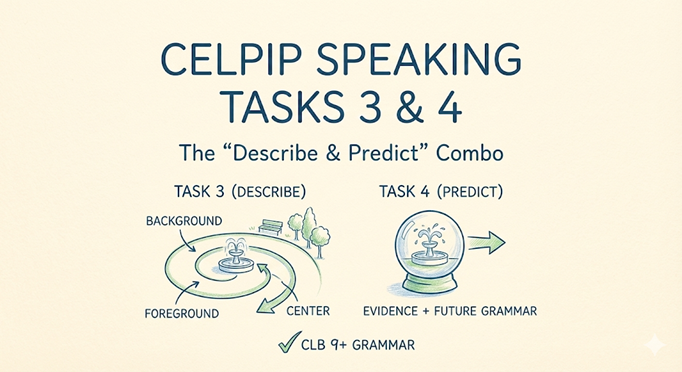
    Next, stop jumping around. Use the “Spiral Method” to organize your answer. Imagine a spiral starting from the center of the picture and winding outward.

    1. The Center (The Anchor): Start with the most obvious action in the middle. This grounds the listener.
    2. The Foreground (The Details): Move to the specific details closest to “camera.”
    3. The Background (The Setting): End with the scenery, weather, or buildings in the distance.

    The “Spiral” in Action (Sample: A Busy Park Scene)

    • Center: “In the center of the scene, there is a large fountain where several children are splashing water.”
    • Spiral Out (Foreground): “Moving to the immediate foreground, a woman is sitting on a bench reading a newspaper, oblivious to the noise.”
    • Spiral Out (Background): “Finally, in the background, storm clouds are gathering over the city skyline, suggesting rain is imminent.”

    The “Preposition Cheat Sheet” (Vocabulary Upgrade)

    Furthermore, you cannot score a CLB 9 if you only use “next to” or “on the left.” You need precise spatial vocabulary.

    Memorize these upgrades:

    Basic Level (Avoid)Advanced Level (Use This)
    “On the left”On the left-hand side of the image…
    “In the front”In the immediate foreground…
    “In the back”In the far background…
    “Next to”Directly adjacent to…
    “Between”Sandwiched between…

    Task 4 Strategy: The “Crystal Ball” Technique

    After describing the scene, the test asks you to predict what will happen next based on the same picture.

    Admittedly, you cannot see the future. However, the test isn’t asking for wild guesses. It is asking for evidence-based predictions.

    Specifically, look for “incomplete actions.”

    • Evidence: A waiter is tripping over a rug while holding a tray.
    • Prediction: He is going to drop the food.

    Level 6 vs. Level 9 Predictions (Grammar Check)

    Finally, the difference between a CLB 6 and a CLB 9 is your grammar variety. Do not just use “will” for every sentence.

    The “Will” Trap (CLB 6)

    “The waiter will fall. The food will go everywhere. The customer will be mad.” (This is repetitive and robotic).

    The “Advanced Future” Flow (CLB 9)

    “Based on his posture, it appears highly likely that the waiter is on the verge of losing his balance.” “Consequently, the tray of drinks is about to crash onto the floor.” “Once this happens, the customers nearby are likely going to react with shock.”

    See the difference? The CLB 9 answer uses modals (“appears likely”), complex future tenses (“on the verge of”), and connectors (“Consequently”).

    Why You Need Visual Drills (Not Just Books)

    Ultimately, reading about these strategies is different from applying them. You look at a picture and think “on the left,” but under stress, you might say “in the left.”

    Unfortunately, small preposition errors significantly lower your score.

    This is where Exam Hero helps you master the visuals.

    • Interactive “Hotspot” Drills: We show you a scene and highlight a specific area. You must immediately use the correct spatial phrase (e.g., “In the background”).
    • Prediction Training: We show you an “incomplete action” and force you to use advanced future grammar to predict the outcome.
    • Preposition Correction: Our AI listens specifically for errors with “in,” “on,” and “at,” correcting your spatial grammar instantly.

    [Stop getting lost in the picture. Master Tasks 3 & 4 with the Smart AI Coach.]

  • CELPIP Speaking Task 5: The Two-Brain Strategy for Comparing & Persuading

    CELPIP Speaking Task 5: The Two-Brain Strategy for Comparing & Persuading

    You look at the screen. You see two pictures: a Fridge ($500) and a Fridge ($700). You choose one. Immediately, the screen changes. Now you see a new option, and you have 60 seconds to convince your friend that your choice is better.

    Suddenly, you feel overwhelmed. You have to remember the prices, compare the features, and be polite to your “friend”—all at the same time.

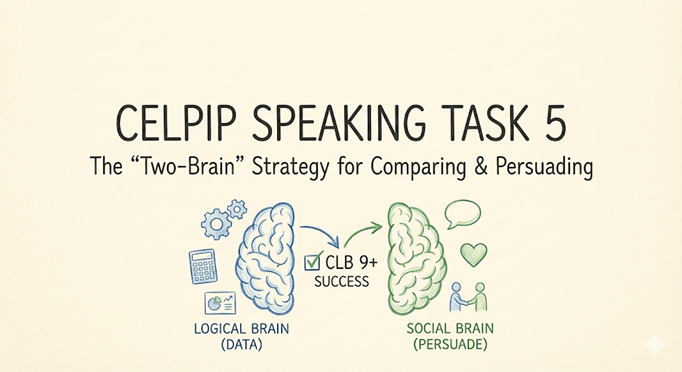
    Undoubtedly, CELPIP Speaking Task 5 is the mental gymnastics section of the exam. It requires you to use two different parts of your brain: your logical brain (for data) and your social brain (for persuasion).

    Consequently, many test-takers stumble because they just list facts like a robot.

    To hit CLB 9+, you need a better approach. Below is the “Two-Brain Strategy” to help you master Comparing and Persuading.

    The Challenge: Logic vs. Emotion

    First, understand why this task is hard. You are not just describing a picture. You are making an argument.

    Specifically, you must do two things simultaneously:

    1. Compare (Logic): You must prove why Option A is mathematically superior to Option B (cheaper, bigger, faster).
    2. Persuade (Emotion): You must speak to a “family member” or “friend,” which means your tone must be warm and understanding.

    Therefore, if you only list the specs (“This fridge is $500. That one is $700”), you fail. You need to connect those facts to your friend’s needs.

    Step 1: The “Comparative” Vocabulary (Logic)

    Next, focus on your grammar. This task is a trap for simple sentences.

    Crucially, you must use comparative adjectives. Do not say “The fridge is cheap.” Instead, say “This fridge is significantly cheaper than the other option.”

    Use these power words to boost your score:

    • Far superior: “The location is far superior.”
    • Slightly more: “It is only slightly more expensive.”
    • Much better suited: “This car is much better suited for your family.”

    Step 2: The “Even Though” Formula (Emotion)

    However, logic is not enough. You need to address the “elephant in the room.” Usually, the option you choose has one big negative (e.g., it is more expensive).

    If you ignore the negative, you sound dishonest. Conversely, if you admit it, you sound trustworthy.

    Consequently, use the “Even Though” Formula. This allows you to acknowledge the flaw before crushing it with a benefit.

    • Structure: “Even though [Negative Point], I believe [Choice] is better because [Strong Positive Point].”
    • Example:Even though this apartment is smaller, I think it is the better choice because it is right next to your office.”

    Putting It All Together: A Sample Script

    Now, let’s see this in action.

    • Scenario: Choosing a gift for a child.
    • Option A: Educational Book (Boring but useful).
    • Option B: Toy Robot (Fun but expensive).

    “Hey Sarah, I know we are trying to decide on a gift for Timmy. (Social)

    Even though the Toy Robot is really cool, I strongly feel we should get the Educational Book. (Even Though Formula)

    “The main reason is that the book is far more useful for his schoolwork than the toy. Also, the book is significantly cheaper, which allows us to save money for his birthday party next month. (Comparative Logic)

    “So, considering the price and value, the book is definitely the smarter pick.” (Conclusion)

    Why You Need to Practice “Switching”

    Admittedly, reading this script is easy. However, doing it under a 60-second timer is stressful.

    You need to train your brain to switch from “Data Mode” to “Friend Mode” instantly.

    Ultimately, this is where Exam Hero helps you win.

    • Scenario Comparison: We show you two real-world options (e.g., houses, cars, gifts) and force you to choose one instantly.
    • Tone Check: Our AI listens to your voice. Are you sounding too aggressive? Or are you polite and persuasive?
    • Structure Scoring: We verify that you used comparison words (“better,” “cheaper”) and didn’t just list facts.

    [Master the art of persuasion with the Smart AI Coach.]

  • The Real Difference Between CLB 8 and CLB 9 (It’s Not Vocabulary)

    The Real Difference Between CLB 8 and CLB 9 (It’s Not Vocabulary)

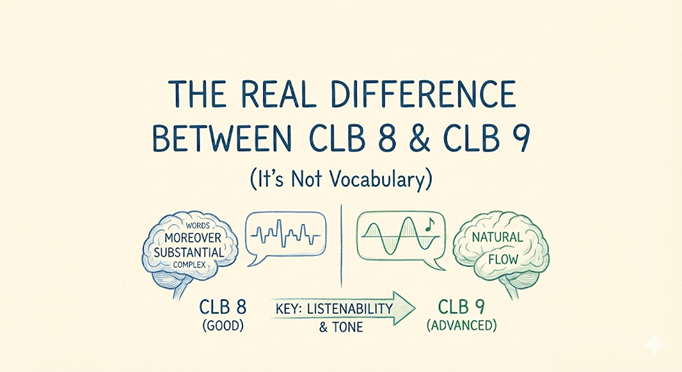
    You memorized the dictionary. You used words like “moreover” and “substantial.” You finished on time. Yet, when the results arrived, you were stuck at a CLB 8.

    Immediately, you assume you need to learn more difficult words.

    However, this is rarely the case. In fact, many students with “simpler” vocabulary score a CLB 9 or 10.

    Surprisingly, the difference between a CLB 8 (good) and a CLB 9 (advanced) is often invisible to the student. It is not about what you say, but how you say it.

    Below are the two hidden factors, Listenability and Task Fulfillment, that actually determine your score.

    Factor #1: Listenability (The Rhythm of English)

    First, understand that CELPIP raters are human. They listen to hundreds of recordings a day. If your answer is hard to follow, they subconsciously lower your score.

    Specifically, this is called “Listenability.”

    • CLB 8 Speaker: Uses great vocabulary but speaks in a “choppy” robot voice. They pause in the wrong places (e.g., “I went to. The store.”)
    • CLB 9 Speaker: Uses natural rhythm. They link words together (e.g., “I went-to-the store”) and use intonation to highlight key ideas.

    Consequently, a simple sentence spoken with perfect rhythm scores higher than a complex sentence spoken with a flat, robotic tone.

    Factor #2: Task Fulfillment (Did You Actually Answer?)

    Next, look at your content. Did you answer the entire prompt, or just the part you liked?

    Admittedly, this seems obvious. However, CLB 8 students often miss the “hidden” parts of the prompt.

    • The Prompt: “Talk to your neighbor. Apologize for the noise, explain why you were loud, and offer a solution.”
    • The CLB 8 Mistake: They spend 50 seconds explaining why they were loud (because it’s easy) and only 5 seconds apologizing. They forget the solution entirely.
    • The CLB 9 Strategy: They treat all three distinct parts equally. They apologize (15s), explain (20s), and solve (20s).

    Therefore, if you miss even one bullet point, you are capped at a CLB 8, no matter how perfect your grammar is.

    Factor #3: Tone Consistency

    Furthermore, your “Tone” must match the situation perfectly.

    • CLB 8: “Hey boss, I want to tell you about a problem.” (Too casual for a formal email).
    • CLB 9: “Dear Mr. Smith, I am writing to bring a serious issue to your attention.” (Perfectly formal).

    Crucially, if you mix tones, starting formal and ending casual, you confuse the rater. You must pick a “character” and stay in character until the end.

    Why You Cannot Grade Yourself

    Unfortunately, you cannot hear your own rhythm errors. Your brain “autocorrects” your voice when you speak.

    This is why self-study often leads to a score plateau. You keep fixing your vocabulary when you should be fixing your pause times.

    Ultimately, you need objective data. This is where Exam Hero excels.

    • Intonation Analysis: Our AI visualizes your voice pitch. Are you flat? Or are you using natural highs and lows?
    • Pause Detection: We flag awkward pauses that destroy your “Listenability” score.
    • Task Check: Our system verifies that you covered every bullet point in the prompt.

    [Stop guessing your score. Get a real analysis with Exam Hero.]