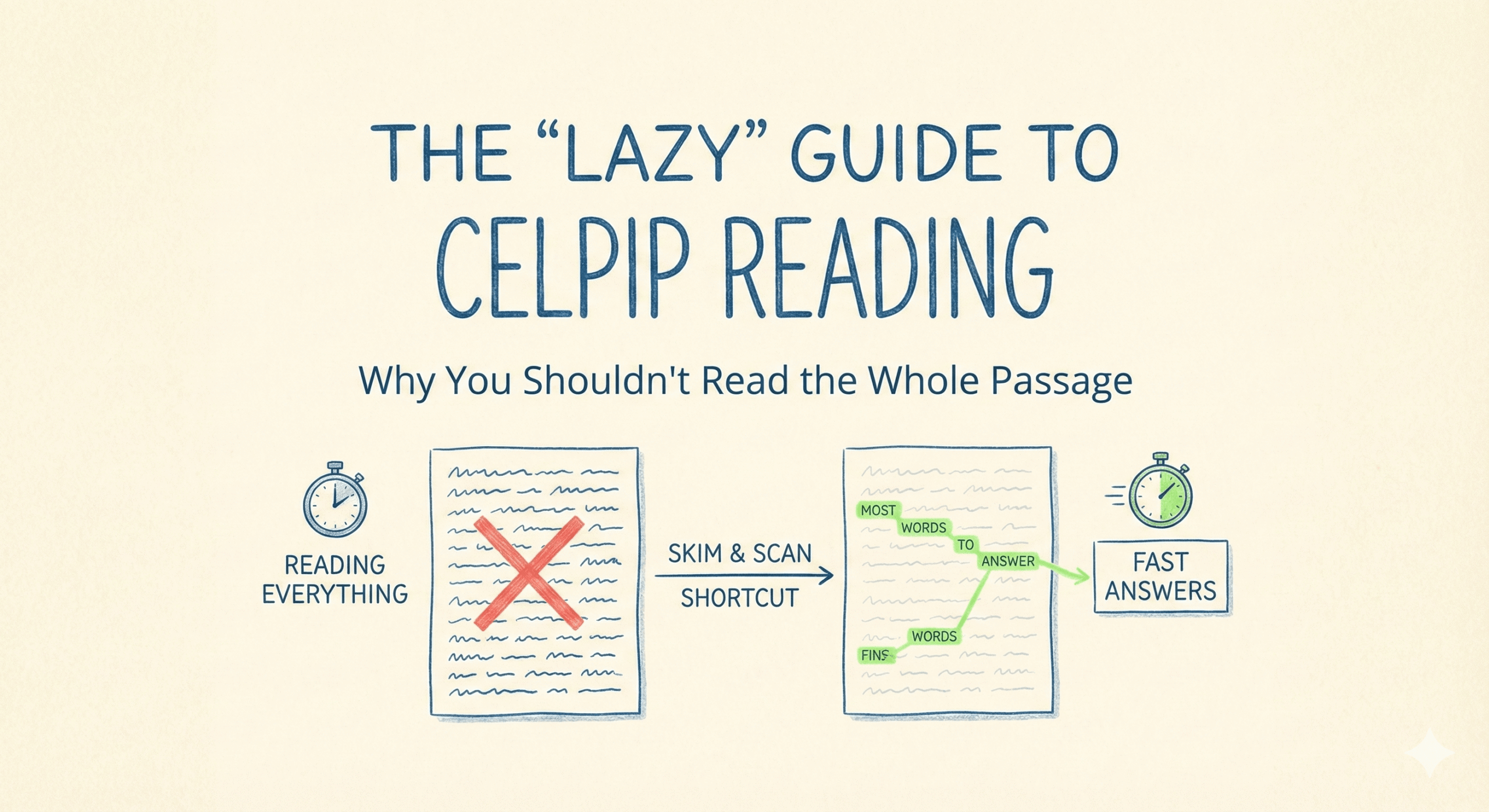
You open the Reading section. You see a long article about Canadian history or a complex email chain. Immediately, you start reading from the first word to the last. Five minutes later, you are only halfway through, and the timer is flashing red.
Surprisingly, your hard work is actually hurting your score.
In fact, the highest-scoring students are often the “laziest” readers. They do not read every word. Instead, they use strategic shortcuts to find the answers without wasting time on the fluff.
Below is the “Lazy” Guide to CELPIP Reading, showing you exactly how to skim, scan, and score a CLB 9 without reading the whole passage.
The “First and Last” Rule (Skimming)
First, you must understand the structure of English writing. Typically, the most important information is not hidden in the middle of a paragraph. It is at the edges.
Therefore, when you first look at a text, do not read the body sentences. Exclusively, read:
- The Title: This tells you the main topic.
- The First Sentence of Each Paragraph: This usually contains the “Main Idea.”
- The Last Sentence of Each Paragraph: This often summarizes the point.
Consequently, by reading only these specific lines, you build a “mental map” of the article in under 60 seconds. You know where information is located without getting bogged down in details.
The “Keyword Hunter” Strategy (Scanning)
Next, stop reading the text and look at the questions. Crucially, you should never read the text deeply until you know what you are looking for.
Specifically, look for “Unchangeable Keywords” in the questions. These are words that cannot be paraphrased, such as:
- Names: “Mr. Smith,” “Vancouver,” “RCMP.”
- Dates & Numbers: “1999,” “$500,” “50%.”
- Technical Terms: “Photosynthesis,” “Visa Application.”
Once you find these keywords in the question, go back to the text and scan for them. Do not read the sentences; just move your eyes until you spot the matching word. Then, read only the sentence around that keyword to find your answer.
The Trap of “Interesting” Articles
Admittedly, sometimes the articles are interesting. You might want to learn about the history of beaver dams in Canada.
However, you must resist this urge. Unfortunately, the test is designed to distract you with interesting but irrelevant details. If you stop to “learn,” you lose time.
Ultimately, treat the text like a data mine. You are there to extract specific nuggets of gold (answers), not to enjoy the scenery. If a sentence does not contain a keyword from a question, ignore it completely.
Why “Lazy” Reading Requires Practice
Undoubtedly, skimming feels uncomfortable at first. Your brain wants to read everything to feel safe.
Consequently, breaking this habit takes training. You cannot learn to speed-read by staring at a static PDF book. You need a tool that forces you to go faster.
This is where Exam Hero gives you the edge.
- Timed Drills: Our AI forces you to answer questions under tight time limits, training your brain to panic less and scan more.
- Keyword Highlighting: Learn to instantly spot the difference between a “distractor” word and a “key” word.
- Progress Tracking: See your reading speed improve day by day as you master the art of the “Lazy” read.
[Stop reading every word. Start scoring higher with Exam Hero.]
Leave a Reply