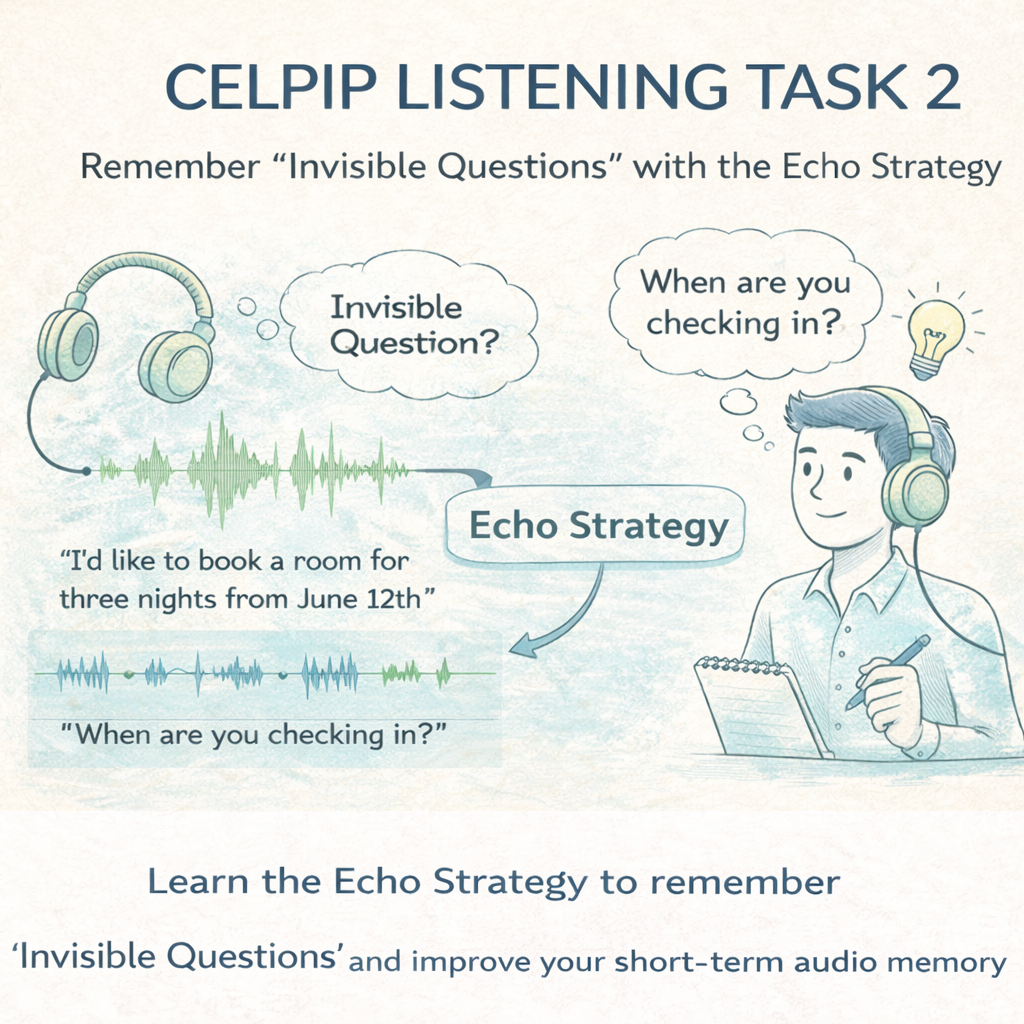
The audio track begins with a conversation about a broken heater or a hiking trip. As you listen, you jot down a few notes and feel confident. Then, the audio stops, and a voice asks a question.
Then, the audio stops. A voice asks a question.
Suddenly, you panic. The question is not on the screen. You have to rely entirely on your memory of what the voice just asked. If you didn’t hear it perfectly, or if you forgot it while looking at the answers, you are guessing blindly.
This is the unique challenge of CELPIP Listening Task 2 (Answering Questions). It is the only part of the test where the question itself is invisible.
To hit CLB 9, you need to stop relying on your eyes and start trusting your “Audio Memory.” Below is the Echo Strategy to ensure you never forget the question.
The Challenge: The Memory Gap
First, understand why this is hard. In other tasks, you can re-read the question while you think. In Task 2, the question exists only for three seconds in the air.
Consequently, many students hear the question, look down at the four options (A, B, C, D), and in that split second of reading the options, they forget the specific detail asked in the question.
- Did they ask WHERE they are going or WHEN they are going?
If you mix up “Where” and “When,” you will pick the wrong answer because the test often includes distractors for both.
The Solution: The “Echo Strategy”
Next, use the Echo Strategy to bridge the gap between hearing and answering.
The Rule: Do not look at the answers immediately.
When the voice asks the question, repeat it silently in your head (Echo it) before you look at the options.
- Audio: “Why did the man refuse the offer?”
- Your Brain (The Echo): “Why refuse? Why refuse? Why refuse?”
- Action: Now look at the options.
This 2-second loop locks the question into your short-term memory so the text on the screen doesn’t distract you.
Note-Taking: The “Q&A” Method
Furthermore, your notes need to change for this section. Since you don’t know the questions, you must capture the Main Points of the dialogue.
Use the Q&A shorthand:
- If the woman asks: “Are you free at 5 PM?”
- And the man says: “No, I have a dentist appointment.”
- Write: Man -> Busy 5pm (Dentist).
You are not just writing words; you are writing the reasoning. The test almost always asks about the reasons (Why), not just the facts (What).
The “tone” Clue
Finally, sometimes the answer is hidden in the speaker’s emotion, not their words.
- Question: What is the woman’s attitude?
- Option A: She is excited about the trip.
- Option B: She is hesitant.
Even if you didn’t understand every word, think back to her voice. Was it high and fast (Excited)? or slow and low (Hesitant)? In Task 2, the intonation is often the biggest clue.
Why You Need Blind Practice
Admittedly, practicing this is hard because most books show you the question. This destroys the purpose of the exercise. You need to practice Blind Listening.
Unfortunately, reading a transcript won’t help your short-term memory.
This is where Exam Hero helps you win.
- Invisible Question Mode: Our app simulates the real test conditions, playing the question via audio only and hiding the text.
- Memory Timer: We train you to hold the question in your head for 5 seconds before answering.
- Echo Drills: We practice “Question Repetition” to strengthen your audio memory loop.
[Stop guessing what you heard. Master the Invisible Question with the Smart AI Coach.]
Leave a Reply