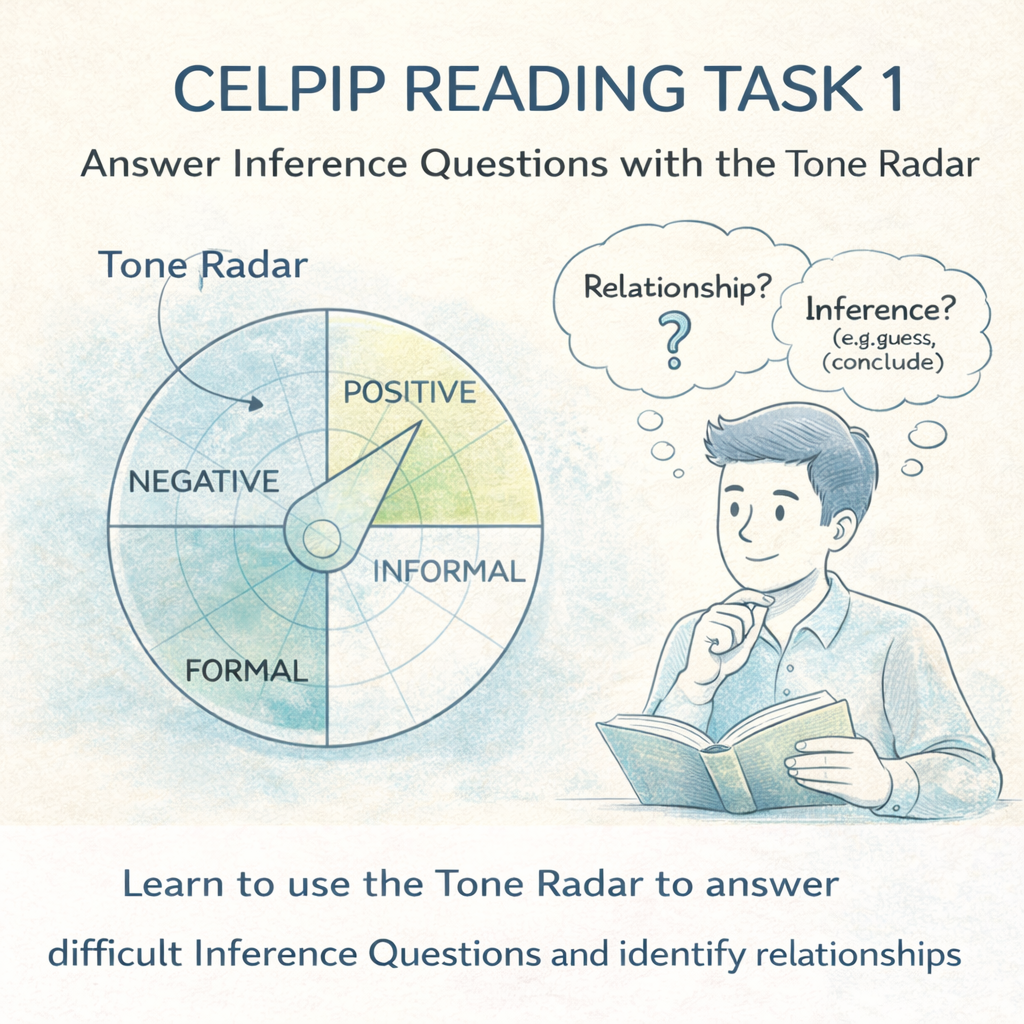
You read the email. It seems simple. A person is writing to someone named John about a meeting. You understand every word.
Then you look at the first question: What is the relationship between the sender and the recipient?
You panic. You scan the text again. Nowhere does it say we are colleagues or we are friends. You start guessing.
This is the hidden trap of CELPIP Reading Task 1. The test does not just measure your ability to read words; it measures your ability to read between the lines. These are called Inference Questions, and they are the main reason students get stuck at CLB 8.
To score a CLB 9, you need to stop looking for facts and start looking for clues. Below is the Tone Radar strategy to help you find answers that are not explicitly written.
The Challenge: The Information Gap
First, you must understand that Canadian culture is high-context. We often do not state the obvious.
For example, if I am writing to my boss, I do not start the email by saying: Since you are my boss, I am writing to you. That would be weird. Instead, I show that relationship through my Tone.
Consequently, the test expects you to act like a detective. You must use the formality of the language to deduce the relationship.
The Solution: The Tone Radar
Next, use the Tone Radar technique. Before you answer any questions, look at the Opener and the Closer. These two small areas contain 90% of the relationship clues.
1. The Salutation (The Opener)
- Hi John / Hey John: This indicates a Close relationship (Friend, Family, or Close Colleague).
- Dear Mr. Smith: This indicates a Formal relationship (Client, Stranger, or Boss).
- Dear John: This is the Neutral Zone (could be a Colleague or an Acquaintance).
2. The Sign-Off (The Closer)
- Love / Cheers / Best: This confirms a Personal connection.
- Sincerely / Regards: This confirms a Professional or Distant connection.
- Thanks: This is neutral but usually implies a Request was made.
Therefore, if the email starts with Hey John and ends with Cheers, the answer to What is the relationship? is almost certainly Friends or Close Colleagues, even if the text never says the word friend.
How to Spot Hidden Emotions
Furthermore, you will often face questions about how the writer feels.
- Question: How does the writer feel about the delay?
- Text: I was a bit surprised to hear about the schedule change.
In Canadian English, we rarely say I am angry. We use softeners.
- A bit surprised usually means Annoyed.
- It is unfortunate usually means I am disappointed.
- I would appreciate usually means I expect you to do this.
If you take the literal meaning, you will choose Suprised (Neutral). If you use your Tone Radar, you will correctly choose Annoyed (Negative).
The Reference Trap (This and That)
Finally, pay close attention to pronouns like This, That, and It.
In CELPIP Reading Task 1, a common question will ask: What does the writer mean by ‘this situation’?
To find the answer, you must look at the sentence immediately before the pronoun.
- Text: The printer has been broken for a week, and the repair technician cancelled twice. This situation is unacceptable.
- Question: What is the situation?
- Answer: The combination of the broken printer AND the cancelled technician. (Many students make the mistake of only choosing the broken printer).
Why You Need Inference Drills
Admittedly, reading between the lines is the hardest skill to learn because it is cultural. You cannot memorize it from a dictionary; you must experience it.
Unfortunately, most free practice tests only ask literal questions. They do not train you for the subtle inference questions on the real exam.
This is where Exam Hero gives you the edge.
- Inference Training: We specifically highlight the Tone Clues in every practice email so you learn to spot them.
- Cultural Decoder: Our AI explains why a bit surprised actually means angry in a Canadian workplace context.
- Pronoun Hunt: We force you to link every This and That to its correct reference, ensuring you never miss a reference question.
[Stop guessing the relationship. Master Inference with the Smart AI Coach.]
Leave a Reply