You open the writing prompt. It says: You borrowed a book from your local library and lost it. Write an email to the librarian to apologize, explain what happened, and offer a solution.
Immediately, you feel nervous. You know how to complain, but do you know how to say sorry correctly in Canada?
This is the challenge of CELPIP Writing Task 1 (The Apology). Unlike a complaint, where you need to be firm, an apology requires you to be humble, sincere, and responsible. If you sound too casual, you will seem rude. If you sound too dramatic, you will seem unprofessional.
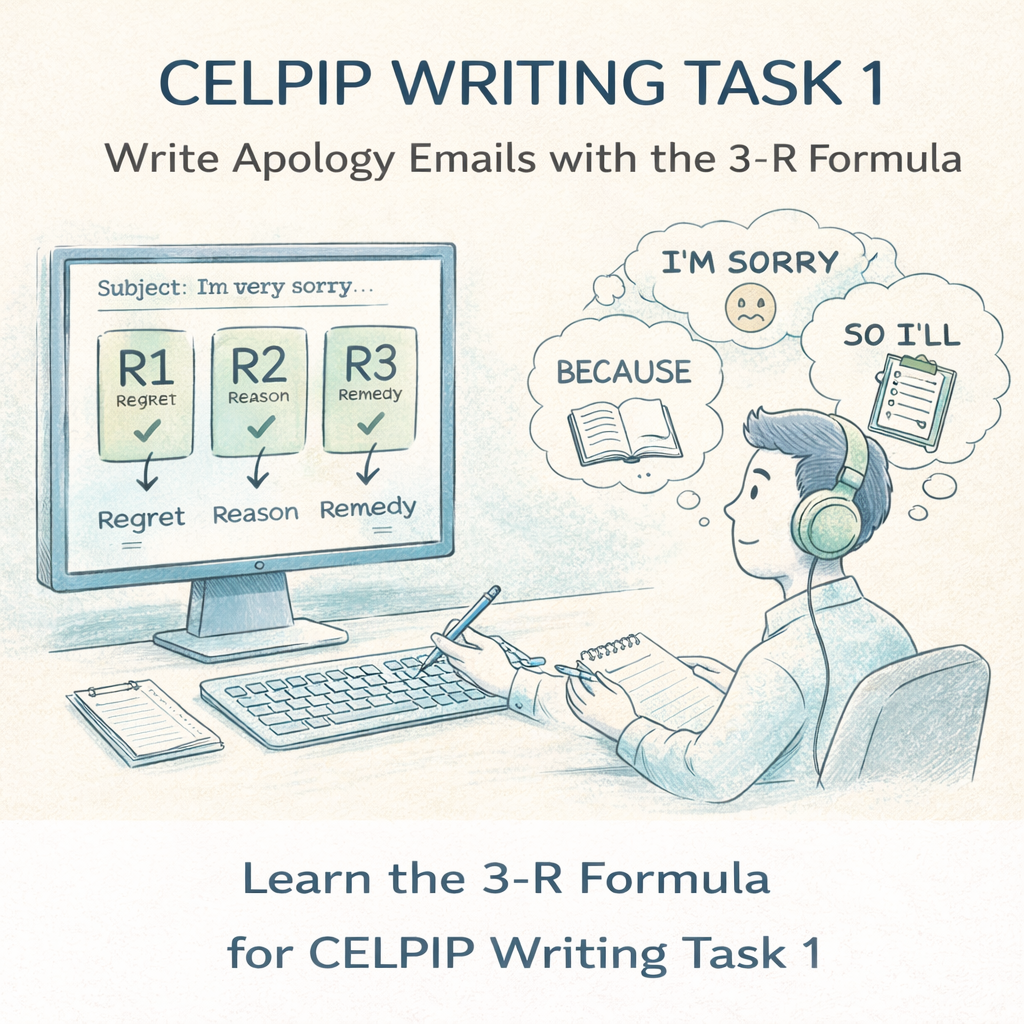
To hit CLB 9, you need the perfect balance. Below is the 3-R Formula, a simple template to ensure your apology is accepted every time.
The Challenge: Tone is Everything
First, understand that the raters are judging your Tone more than your truthfulness. They do not care if you actually lost a book. They care if you sound like a polite, responsible adult.
Consequently, you must avoid the Defensive Trap. This is when you apologize but immediately blame someone else.
- Bad Tone (Defensive): I am sorry I missed the meeting, but the traffic was terrible and my alarm broke.
- Good Tone (Responsible): Please accept my sincere apologies for missing the meeting. I failed to account for the heavy traffic this morning.
See the difference? The first one makes excuses. The second one takes responsibility.
The Solution: The 3-R Formula
Next, structure your email using the 3-R Formula. This ensures you cover all the bullet points in the prompt without getting off track.
1. Regret ( The Immediate Apology)
Start your email by apologizing immediately in the first sentence. Do not bury the lead.
- Formal Phrase: Please accept my sincerest apologies for…
- Informal Phrase: I am so incredibly sorry about…
2. Reason (The Honest Explanation)
Then, briefly explain what happened. Keep it simple and believable. Do not write a long, complicated story.
- Example: While I was moving apartments last weekend, the box containing the library book was unfortunately misplaced by the movers.
3. Remedy (The Solution)
Finally, offer a way to fix the problem. This is the most important part because it shows you are solution-oriented.
- Example: I would like to pay for the full replacement cost of the book. Please let me know the amount so I can transfer the funds immediately.
Formal vs. Informal Apologies
Furthermore, you must adjust your vocabulary based on who you are emailing.
If writing to a Boss or Librarian (Formal):
- Use: I apologize / I regret to inform you / Please forgive the oversight.
- Avoid: I messed up / Sorry about that / My bad.
If writing to a Friend or Neighbor (Informal):
- Use: I feel terrible / I am so sorry / I can’t believe I did this.
- Avoid: Please accept my formal apology / I regret the incident.
Why You Need Tone Feedback
Admittedly, judging your own tone is nearly impossible. You might think you sound polite, but a native speaker might think you sound sarcastic or cold.
Unfortunately, Microsoft Word will check your spelling, but it will not check your politeness level.
This is where Exam Hero excels.
- Tone Detector: Our AI analyzes your writing and tells you if you sound angry, defensive, or sincere.
- Template Training: We force you to practice the 3-R Formula until it becomes automatic.
- Formal vs. Informal Drills: We give you the same scenario (e.g., being late) and ask you to write it twice: once for a boss, and once for a friend.
[Stop guessing your tone. Write perfect emails with the Smart AI Coach.]
Leave a Reply