You look at the screen. You see two pictures: a Fridge ($500) and a Fridge ($700). You choose one. Immediately, the screen changes. Now you see a new option, and you have 60 seconds to convince your friend that your choice is better.
Suddenly, you feel overwhelmed. You have to remember the prices, compare the features, and be polite to your “friend”—all at the same time.
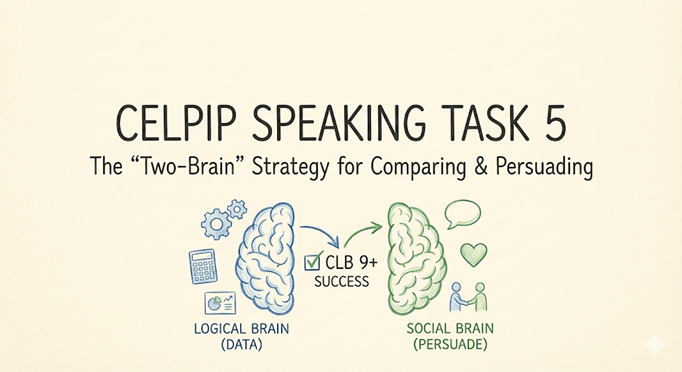
Undoubtedly, CELPIP Speaking Task 5 is the mental gymnastics section of the exam. It requires you to use two different parts of your brain: your logical brain (for data) and your social brain (for persuasion).
Consequently, many test-takers stumble because they just list facts like a robot.
To hit CLB 9+, you need a better approach. Below is the “Two-Brain Strategy” to help you master Comparing and Persuading.
The Challenge: Logic vs. Emotion
First, understand why this task is hard. You are not just describing a picture. You are making an argument.
Specifically, you must do two things simultaneously:
- Compare (Logic): You must prove why Option A is mathematically superior to Option B (cheaper, bigger, faster).
- Persuade (Emotion): You must speak to a “family member” or “friend,” which means your tone must be warm and understanding.
Therefore, if you only list the specs (“This fridge is $500. That one is $700”), you fail. You need to connect those facts to your friend’s needs.
Step 1: The “Comparative” Vocabulary (Logic)
Next, focus on your grammar. This task is a trap for simple sentences.
Crucially, you must use comparative adjectives. Do not say “The fridge is cheap.” Instead, say “This fridge is significantly cheaper than the other option.”
Use these power words to boost your score:
- Far superior: “The location is far superior.”
- Slightly more: “It is only slightly more expensive.”
- Much better suited: “This car is much better suited for your family.”
Step 2: The “Even Though” Formula (Emotion)
However, logic is not enough. You need to address the “elephant in the room.” Usually, the option you choose has one big negative (e.g., it is more expensive).
If you ignore the negative, you sound dishonest. Conversely, if you admit it, you sound trustworthy.
Consequently, use the “Even Though” Formula. This allows you to acknowledge the flaw before crushing it with a benefit.
- Structure: “Even though [Negative Point], I believe [Choice] is better because [Strong Positive Point].”
- Example: “Even though this apartment is smaller, I think it is the better choice because it is right next to your office.”
Putting It All Together: A Sample Script
Now, let’s see this in action.
- Scenario: Choosing a gift for a child.
- Option A: Educational Book (Boring but useful).
- Option B: Toy Robot (Fun but expensive).
“Hey Sarah, I know we are trying to decide on a gift for Timmy. (Social)
“Even though the Toy Robot is really cool, I strongly feel we should get the Educational Book. (Even Though Formula)
“The main reason is that the book is far more useful for his schoolwork than the toy. Also, the book is significantly cheaper, which allows us to save money for his birthday party next month. (Comparative Logic)
“So, considering the price and value, the book is definitely the smarter pick.” (Conclusion)
Why You Need to Practice “Switching”
Admittedly, reading this script is easy. However, doing it under a 60-second timer is stressful.
You need to train your brain to switch from “Data Mode” to “Friend Mode” instantly.
Ultimately, this is where Exam Hero helps you win.
- Scenario Comparison: We show you two real-world options (e.g., houses, cars, gifts) and force you to choose one instantly.
- Tone Check: Our AI listens to your voice. Are you sounding too aggressive? Or are you polite and persuasive?
- Structure Scoring: We verify that you used comparison words (“better,” “cheaper”) and didn’t just list facts.
Leave a Reply