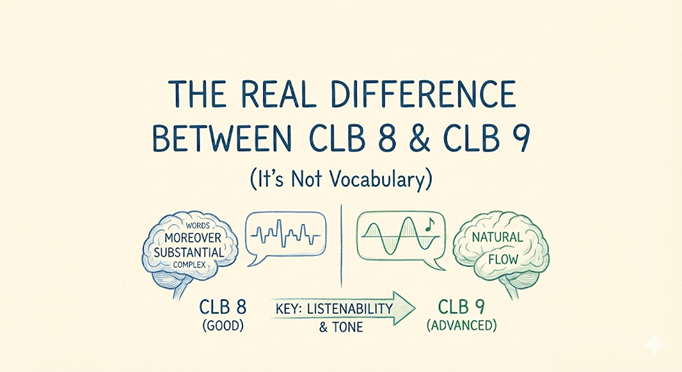
You memorized the dictionary. You used words like “moreover” and “substantial.” You finished on time. Yet, when the results arrived, you were stuck at a CLB 8.
Immediately, you assume you need to learn more difficult words.
However, this is rarely the case. In fact, many students with “simpler” vocabulary score a CLB 9 or 10.
Surprisingly, the difference between a CLB 8 (good) and a CLB 9 (advanced) is often invisible to the student. It is not about what you say, but how you say it.
Below are the two hidden factors, Listenability and Task Fulfillment, that actually determine your score.
Factor #1: Listenability (The Rhythm of English)
First, understand that CELPIP raters are human. They listen to hundreds of recordings a day. If your answer is hard to follow, they subconsciously lower your score.
Specifically, this is called “Listenability.”
- CLB 8 Speaker: Uses great vocabulary but speaks in a “choppy” robot voice. They pause in the wrong places (e.g., “I went to. The store.”)
- CLB 9 Speaker: Uses natural rhythm. They link words together (e.g., “I went-to-the store”) and use intonation to highlight key ideas.
Consequently, a simple sentence spoken with perfect rhythm scores higher than a complex sentence spoken with a flat, robotic tone.
Factor #2: Task Fulfillment (Did You Actually Answer?)
Next, look at your content. Did you answer the entire prompt, or just the part you liked?
Admittedly, this seems obvious. However, CLB 8 students often miss the “hidden” parts of the prompt.
- The Prompt: “Talk to your neighbor. Apologize for the noise, explain why you were loud, and offer a solution.”
- The CLB 8 Mistake: They spend 50 seconds explaining why they were loud (because it’s easy) and only 5 seconds apologizing. They forget the solution entirely.
- The CLB 9 Strategy: They treat all three distinct parts equally. They apologize (15s), explain (20s), and solve (20s).
Therefore, if you miss even one bullet point, you are capped at a CLB 8, no matter how perfect your grammar is.
Factor #3: Tone Consistency
Furthermore, your “Tone” must match the situation perfectly.
- CLB 8: “Hey boss, I want to tell you about a problem.” (Too casual for a formal email).
- CLB 9: “Dear Mr. Smith, I am writing to bring a serious issue to your attention.” (Perfectly formal).
Crucially, if you mix tones, starting formal and ending casual, you confuse the rater. You must pick a “character” and stay in character until the end.
Why You Cannot Grade Yourself
Unfortunately, you cannot hear your own rhythm errors. Your brain “autocorrects” your voice when you speak.
This is why self-study often leads to a score plateau. You keep fixing your vocabulary when you should be fixing your pause times.
Ultimately, you need objective data. This is where Exam Hero excels.
- Intonation Analysis: Our AI visualizes your voice pitch. Are you flat? Or are you using natural highs and lows?
- Pause Detection: We flag awkward pauses that destroy your “Listenability” score.
- Task Check: Our system verifies that you covered every bullet point in the prompt.
[Stop guessing your score. Get a real analysis with Exam Hero.]
Leave a Reply