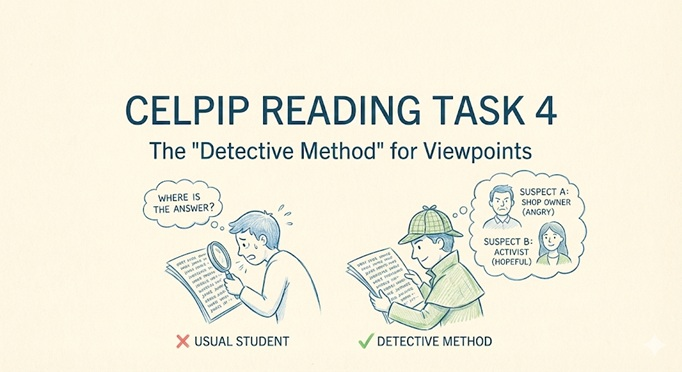
You reach the final section of the Reading test. You are tired. You see an article about a controversial topic, like “Banning Plastic Bags” or “School Uniforms.”
Suddenly, the questions get harder. They don’t ask for facts like dates or names. They ask: “What would the writer most likely agree with?” or “How does the second commenter feel about the proposal?”
You scan the text for the answer, but it’s not there.
Unfortunately, you cannot “find” the answer because it isn’t written. You have to infer it.
This is CELPIP Reading Task 4: Reading for Viewpoints. To solve it, you need to stop acting like a student and start acting like a Detective.
The Core Problem: Fact vs. Inference
First, you must understand why this task is unique. In Tasks 1-3, you are a “Fact Hunter.” You look for a keyword, find the sentence, and match the answer.
In contrast, Task 4 tests “Inference.” You must read between the lines to understand the hidden opinions of the people involved.
Therefore, if you only look for matching words, you will choose the “distractor” answers every time. You need the “Detective Method.”
Step 1: Profile the “Suspects” (The Speakers)
Immediately upon reading the article, identify the key players. Usually, there are 2-3 distinct groups or people mentioned.
Specifically, create a quick mental profile for each:
- Who are they? (e.g., “The Shop Owners” vs. “The Environmentalists”)
- What is their motive? (e.g., “Shop owners want to save money,” “Environmentalists want to save the ocean”)
- What is their Tone? (e.g., “Angry,” “Hopeful,” “Resigned”)
Consequently, when a question asks, “How would the shop owners react to a tax increase?”, you don’t need to find a sentence about taxes. You know their motive is saving money, so you can infer they would be angry.
Step 2: Spot the “Hidden Clues” (Modals & Adjectives)
Next, look for the subtle words that reveal a suspect’s true feelings. A Detective looks for micro-expressions; you look for modals and adjectives.
- The “Polite No”: If a writer says, “While the plan has merit, it may be premature,” they are actually saying NO.
- The “Hidden Yes”: If they say, “It is a step in the right direction,” they support it, but with reservations.
- The “Intensifiers”: Words like clearly, obviously, or undeniably signal a very strong, unshakeable opinion.
Step 3: Solve the “Comment” Mystery
The second half of Task 4 is a “Reply Comment” with fill-in-the-blanks. This is where most students lose points.
Crucially, the commenter is usually reacting to the main article. To fill the blanks, you must determine: Is this person a friend or an enemy of the main writer?
- If they are an Enemy: They will use sarcasm or contrasting words (However, actually, unfortunately).
- If they are a Friend: They will echo the main writer’s points using synonyms.
Ultimately, once you identify their “allegiance,” the missing words become obvious.
Why You Can’t Practice This with Simple Articles
Admittedly, you can practice reading news online. However, generic news articles don’t test your ability to infer bias under time pressure.
You need training materials that are specifically designed to be “tricky.”
This is where Exam Hero gives you the edge.
- Inference Drills: Our questions force you to guess the speaker’s mood, not just their words.
- Bias Detection: We highlight the “hidden clue” words so you learn to spot sarcasm and “soft no’s.”
- Timed Profiling: Learn to identify the “suspects” and their motives in under 60 seconds.
[Stop searching for words. Start solving the case with Exam Hero.]
Leave a Reply