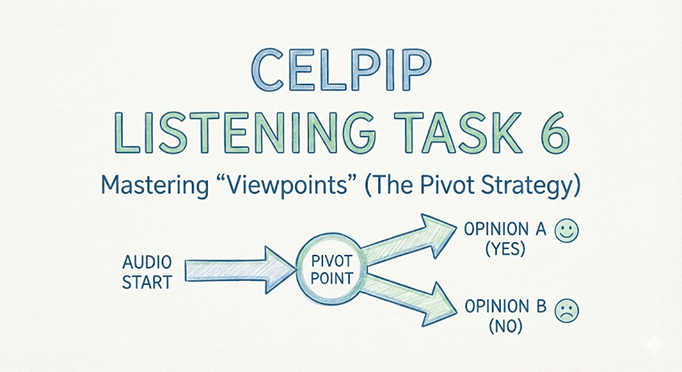
The audio begins. A man and a woman are debating a complex topic, like “Universal Basic Income” or “banning cars in the city center.” They talk for three long minutes. They switch sides. They agree on some points but disagree on others.
By the end, you are completely confused about who supports what.
Undoubtedly, CELPIP Listening Task 6 (Viewpoints) is the hardest part of the Listening test. It tests your ability to follow a winding, abstract argument.
However, you do not need a degree in philosophy to score a CLB 9. You just need to stop listening for facts and start listening for “pivots.”
Below is the “Contrast Mapping” strategy to help you track the debate without getting lost.
The Trap: Listening for Facts
First, understand why you are failing. In earlier tasks, you listened for facts (e.g., “The bus arrives at 3 PM”).
In contrast, Task 6 is about opinions. The speakers often state a fact only to disagree with it immediately.
- Example: “Some people say that banning cars would reduce pollution.” (This is not the speaker’s opinion; it’s a general statement).
- Next Sentence: “However, I believe it would destroy local businesses.” (This IS the speaker’s opinion).
Consequently, if you write down “reduce pollution” as the man’s opinion, you get the answer wrong. You missed the pivot.
The “Pivot Word” Strategy
Therefore, your ears must be trained to hunt for Pivot Words. These are the signals that the speaker is about to state their real view.
Specifically, listen for these three categories:
1. The Disagreement Pivot (The “But”)
When you hear these, the speaker is rejecting the previous idea.
- Keywords: However, On the other hand, Although, Conversely.
- Action: If you hear this, cross out your previous note. The real opinion is coming next.
2. The Agreement Pivot (The “Yes”)
When you hear these, the speaker is aligning with the other person.
- Keywords: Precisely, I couldn’t agree more, That’s a valid point, Exactly.
- Action: Draw a
(+)symbol next to the speaker’s name in your notes.
3. The “Soft” Disagreement (The “Yes, but…”)
This is the trickiest one. They agree politely before destroying the argument.
- Keywords: While that may be true…, I see where you’re coming from, but…
- Action: Wait for the “but.” Everything before the “but” is polite fluff. Everything after is the answer.
How to Take Notes: The “VS” Column
Next, you need a better note-taking system. Do not write sentences.
Instead, create a simple “VS” (Versus) chart on your paper.
- Left Side: Pro-Topic (e.g., “For Banning Cars”)
- Right Side: Anti-Topic (e.g., “Against Banning Cars”)
As you listen, when the man makes a point, put a letter “M” on the side he supports. If the woman agrees, put a “W” next to him. If she disagrees, put a “W” on the opposite side.
Ultimately, this gives you a visual map of the debate. You can look at your paper and instantly see: “The Man is mostly on the Left, but the Woman is on the Right.”
Why You Need to Train Your “Pivot Ears”
Admittedly, spotting these words in a fast conversation is hard. You might know the word “Conversely” when reading, but can you hear it when spoken quickly?
Unfortunately, reading this blog post is not enough. You need active ear training.
This is where Exam Hero excels.
- Pivot Drills: We highlight the transition words in our audio exercises so you learn to hear them.
- Complex Debates: Practice with 3-minute arguments on tough topics like economics, education, and technology.
- Comprehension Checks: We test if you understood the relationship between speakers, not just the topic.
[Stop getting lost in the debate. Master Task 6 with Exam Hero.]
Leave a Reply