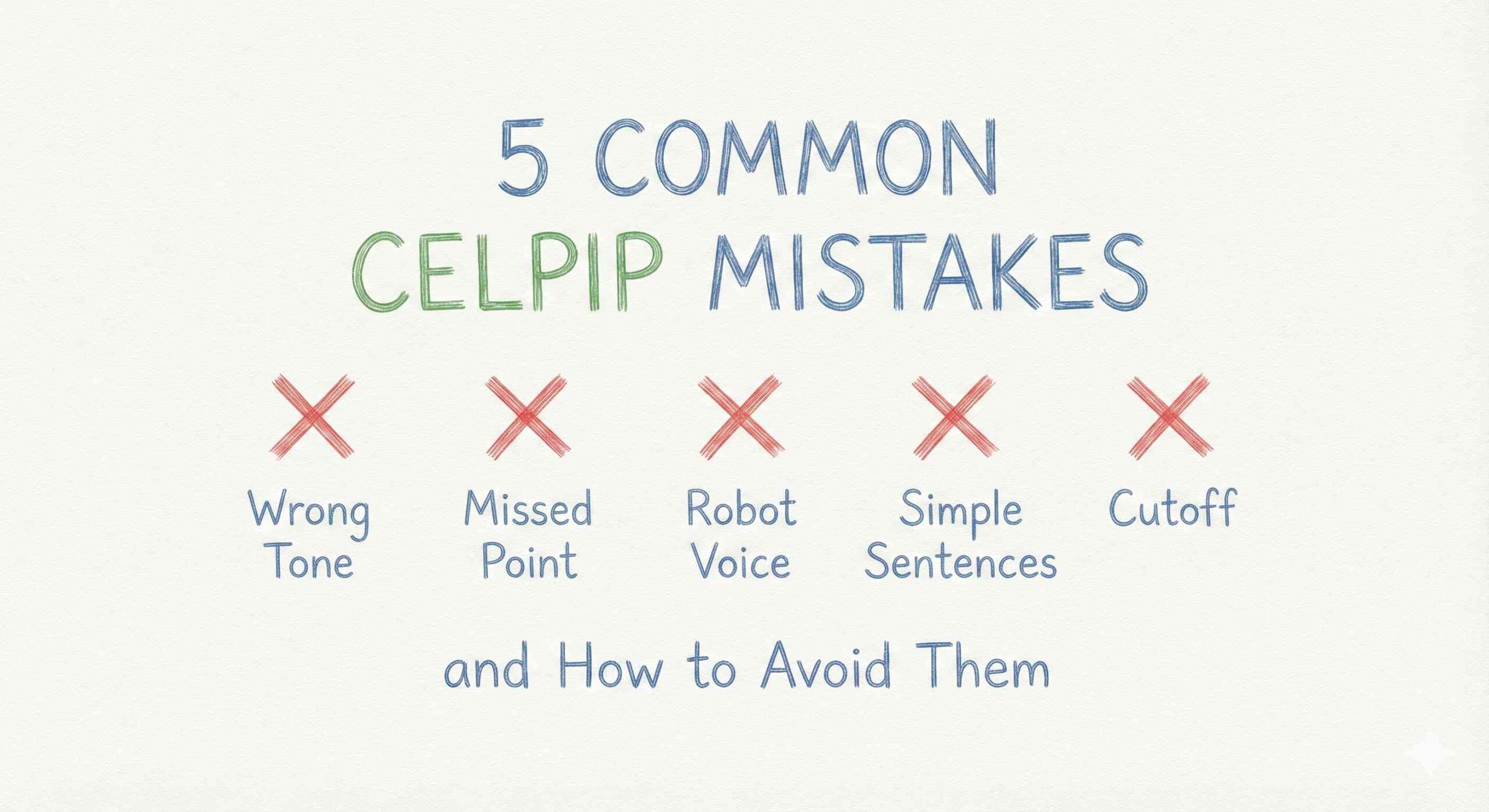
After studying for weeks and memorizing every template, you likely felt confident on test day. But when the results arrived, you saw a CLB 7 instead of the CLB 9 you needed. What went wrong? The answer usually lies in specific, common CELPIP mistakes that many test-takers make without realizing it.
Surprisingly, the problem isn’t necessarily a lack of English knowledge. Instead, it is often a lack of strategy. Because the CELPIP is unique, even smart students fall into the same traps repeatedly.
Below, we list the 5 most common CELPIP mistakes holding your score down, and the simple fixes to help you succeed.
Mistake #1: Treating CELPIP Like IELTS (The “Tone” Trap)
This serves as the number one score-killer for people switching from IELTS.
- The Mistake: Using overly formal, academic language in tasks that require a natural, functional tone.
- Why It Hurts: CELPIP tests “functional English.” It measures how you speak to a boss, a neighbor, or a friend in Canada. If you write a complaint email to a store manager sounding like a 19th-century professor (e.g., “Furthermore, I implore you to rectify this egregious error”), raters will penalize you for “Tone.”
- The Fix: Visualize a real person. If the task involves talking to a friend, use contractions (I’m, we’re). Conversely, if speaking to a boss, be polite but direct. Stop trying to impress the rater with big words you do not normally use.
Mistake #2: Missing a Bullet Point (The “Task Fulfillment” Fail)
This sounds obvious, yet it happens constantly in Writing Task 1 and Speaking tasks with multiple prompts.
- The Mistake: Getting so focused on writing a great introduction that you forget to address one of the three required bullet points in the prompt.
- Why It Hurts: Raters look at “Task Fulfillment” first. If you miss a bullet point, you fail the task criteria. Consequently, your score cap drops immediately, no matter how perfect your grammar is.
- The Fix: Plan before you write or speak. Tick off each bullet point as you cover it. Never submit an answer without double-checking that you addressed all three points.
Mistake #3: Sounding Like a Robot (The “Template Zombie”)
Templates help with structure, but they ruin content if used incorrectly.
- The Mistake: Memorizing entire sentences from YouTube videos and repeating them word-for-word.
- Why It Hurts: Raters listen to thousands of tests and know the popular templates by heart. Therefore, if you sound like a scripted robot, they will lower your score for a lack of natural flow.
- The Fix: Use templates for structure only (e.g., knowing you need an introduction, 2 body paragraphs, and a conclusion). Do NOT memorize full sentences. Instead, practice putting your own ideas into the structure.
Mistake #4: “Simple Sentence Syndrome”
To get a CLB 9+, you must demonstrate sentence variety.
- The Mistake: Writing or speaking in a string of short, simple sentences. “I went to the store. It was closed. I was sad.”
- Why It Hurts: This demonstrates a “basic” command of the language. Raters prefer complex and compound sentences that connect ideas logically.
- The Fix: Use transition words and conjunctions. For instance, turn the example above into: “Although I went to the store yesterday, it was unfortunately closed.”
Mistake #5: The Mid-Sentence Cutoff (Speaking Timing)
The CELPIP timer is unforgiving.
The Fix: Practice with a real timer. Learn what 60 seconds feels like. Always have a short “exit phrase” ready to wrap up your answer in the last 5 seconds.
The Mistake: Trying to say too much and getting cut off by the recording software in the middle of your final sentence.
Why It Hurts: An incomplete thought makes your answer sound disorganized and lowers your score for “Coherence.”
H1: 5 Common CELPIP Mistakes That Are Killing Your Score (And How to Fix Them)
You studied for weeks. You memorized the templates. You felt good on test day. But when the results arrived, you saw a CLB 7 instead of the CLB 9 you needed.
What happened?
It’s likely not a lack of English knowledge. It’s a lack of CELPIP strategy. The CELPIP is a unique test, and many smart test-takers fall into the same traps over and over again.
Here are the 5 most common CELPIP mistakes that are holding your score down, and the simple fixes to get you to the next level.
H2: Mistake #1: Treating CELPIP Like IELTS (The “Tone” Trap)
This is the #1 killer of scores for people switching from IELTS.
- The Mistake: Using overly formal, academic language in tasks that require a natural, functional tone.
- Why It Hurts: CELPIP tests “functional English”—how you speak to a boss, a neighbor, or a friend in Canada. If you write a complaint email to a store manager sounding like a 19th-century professor (e.g., “Furthermore, I implore you to rectify this egregious error”), you will lose points for “Tone.”
- The Fix: Imagine a real person. If the task is to talk to a friend, use contractions (I’m, we’re). If it’s to a boss, be polite but direct. Stop trying to impress the rater with big words you don’t normally use.
H2: Mistake #2: Missing a Bullet Point (The “Task Fulfillment” Fail)
This sounds obvious, but it happens constantly in Writing Task 1 and Speaking tasks with multiple prompts.
- The Mistake: Getting so focused on writing a great introduction or using fancy vocabulary that you forget to address one of the three required bullet points in the prompt.
- Why It Hurts: The first criteria raters look at is “Task Fulfillment.” If you miss a bullet point, you have not fulfilled the task. Your score cap drops immediately, no matter how perfect your grammar is.
- The Fix: Plan before you write or speak. Tick off each bullet point as you cover it. Never submit an answer without double-checking that all three points are addressed.
H2: Mistake #3: Sounding Like a Robot (The “Template Zombie”)
The Mistake: Memorizing entire sentences from YouTube videos and repeating them word-for-word.
Why It Hurts: In fact, raters listen to thousands of tests and know the popular templates by heart. As a result, if you sound like a scripted robot, they will lower your score for a lack of natural flow.
The Fix: Use templates for structure only (e.g., knowing you need an introduction, 2 body paragraphs, and a conclusion). Do NOT memorize full sentences. Instead, practice putting your own ideas into the structure.
H2: Mistake #4: “Simple Sentence Syndrome”
To get a CLB 9+, you need to show sentence variety.
- The Mistake: Writing or speaking in a string of short, simple sentences. “I went to the store. It was closed. I was sad.”
- Why It Hurts: This shows a “basic” command of the language. Raters are looking for complex and compound sentences that connect ideas logically.
- The Fix: Use transition words and conjunctions. Turn the example above into: “Although I went to the store yesterday, it was unfortunately closed, which was quite frustrating.” (See our post on CELPIP Vocabulary Words for more help with this).
H2: Mistake #5: The Mid-Sentence Cutoff (Speaking Timing)
Unfortunately, the CELPIP timer is unforgiving.
- The Mistake: Trying to say too much and getting cut off by the recording software in the middle of your final, crucial sentence.
- Why It Hurts: An incomplete thought makes your answer sound disorganized and lowers your score for “Coherence.”
- The Fix: Practice with a real timer. Learn what 60 seconds feels like. Always have a short “exit phrase” ready to wrap up your answer in the last 5 seconds, like “So, that’s my take on the situation,” or “Anyway, I hope that helps.”
You Can’t Fix What You Can’t See
Ultimately, the main problem with these common CELPIP mistakes is that diagnosing them yourself is difficult. First, identifying if your own tone is off takes experience. Second, sounding robotic is often something you do not realize you are doing.
Consequently, you need an objective, expert ear to listen to you and point these errors out.
That is exactly what the Smart AI Coach does.
- Tone Check: The tool flags if your language is too formal or too casual.
- Completion Check: It analyzes your answer to ensure you hit every part of the prompt.
- Timing Training: You will be forced to practice under real time pressure so you never get cut off again.
Stop making the same mistakes over and over. Get the feedback you need to fix them.
Leave a Reply